November 19, 2026
Is B2B SEO Still Relevant in the Age of AI Search?
Share:



Every few years, marketers declare SEO dead. This time, the threat comes with new labels: answer engine optimisation (AEO), generative engine optimisation (GEO) and AI optimisation. The message is familiar: the old rules no longer apply, and businesses must adopt a new strategy to stay visible.
But Google's own guidance tells a different story. AI search is changing how people discover information, not making the fundamentals of SEO obsolete. Crawlable websites, useful content, technical accessibility and genuine expertise still matter. The real challenge for B2B businesses is understanding what has changed, what remains effective and where to invest their marketing resources.
At KLIQ, we see AI search as an evolution of SEO, not a replacement for it. The opportunity lies in building on proven foundations while making your business's expertise easier for buyers to find, understand and trust.
Key Takeaways
- SEO still matters: Google’s AI search features rely on existing SEO fundamentals.
- Buyer behaviour is changing: B2B buyers use AI to research, compare and shortlist suppliers.
- Expertise sets content apart: Original insights and real customer experiences build trust.
- SEO fundamentals remain essential: Technical accessibility, useful content and credibility support visibility.
- Measure business outcomes: Track qualified leads, conversions and sales opportunities, not just traffic.
What does Google's guide to generative AI search say about SEO?
Google's guidance confirms that SEO best practices remain important for its AI search experiences, including AI Overviews and AI Mode. These features build on Google's existing Search ranking and quality systems to retrieve relevant information from its Search index. Its AI systems then use information from those sources to generate responses and provide links to supporting pages.
This does not mean all generative AI platforms use traditional search-engine ranking systems. Each platform has its own approach to finding, selecting and referencing information. Google's guidance specifically explains how its own AI search features work. Two principles help illustrate this process.
Retrieval-augmented generation (RAG), or grounding. Google's systems retrieve relevant information from its Search index. Its AI systems use that information to generate responses, often with links that allow users to explore the original sources.
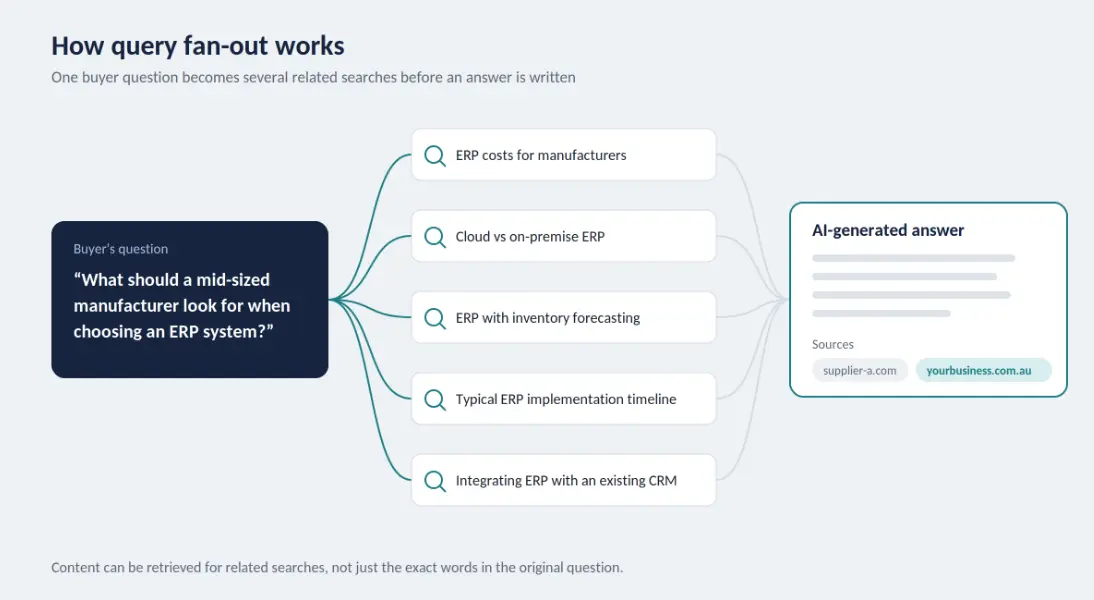
Query fan-out. AI search can expand a user's question into several related searches to gather information from different sources. For example, a buyer asking what a mid-sized manufacturer should look for when choosing an ERP system might also trigger searches about ERP costs for manufacturers, cloud versus on-premises ERP, inventory forecasting features, implementation timelines and CRM integration.
This means a page can be relevant to an AI-generated answer even when it does not target the exact wording of the buyer's original question. Businesses should therefore create content that addresses the wider questions, concerns and considerations behind their customers' searches.
This has changed how we plan content for clients. We no longer just ask which keyword a page should target. We also ask what else a buyer would need to know before making a decision, because that’s exactly what AI search goes looking for.
Google's guidance reinforces the importance of established SEO practices for visibility in its AI search features. Similar foundations matter across other search environments, although each platform works differently. Microsoft Bing's Webmaster Guidelines, for example, emphasise crawling, indexing and well-structured content. Bing also supports Microsoft Copilot's web search experiences. ChatGPT Search and Perplexity can retrieve information from the web and reference sources in their answers.
For B2B businesses, this means visibility should not depend on Google rankings alone. A technically accessible website, useful expert-led content and credible industry mentions can help businesses build a stronger presence across different search and AI discovery platforms.
This is the approach KLIQ takes with its clients. We incorporate AI search considerations into existing SEO strategies rather than treating AI search as an entirely separate discipline. This involves making websites accessible to search engines, creating content that addresses buyers' questions and demonstrating the expertise that gives potential customers and search platforms reasons to trust a business.
The key takeaway is that businesses do not need to abandon SEO or chase a separate set of AI ranking rules. They need to understand how their customers search, publish information that demonstrates genuine expertise and build a credible online presence. AI has changed how buyers discover, research and evaluate businesses, but the importance of earning trust and generating measurable business outcomes remains.
How is AI search changing B2B buyer behaviour?
AI search is changing how B2B buyers discover suppliers, evaluate solutions and build shortlists. The biggest shift is how much research buyers can complete before engaging with a vendor. Three changes stand out.
1. Buyers ask more contextual questions
Buyers increasingly use conversational queries to explore problems, compare solutions and understand trade-offs. Google's AI Mode supports this behaviour by handling complex questions that might previously have required several separate searches.
Also, they can move between search engines, AI assistants, professional networks and supplier websites as they research their options. AI tools are becoming another way to identify potential vendors and build a shortlist for further investigation.
For B2B marketers, this means creating content that answers questions throughout the buying journey. Individual keywords still matter, but businesses also need to address the underlying problems, comparisons and decisions that shape purchasing choices.
2. Visibility no longer guarantees a website visit
AI-generated answers can satisfy basic information needs without sending users to a website. Google says AI Overviews appear when its systems determine they will be useful. It has also reported that clicks from results containing AI Overviews can be higher quality, with users spending more time on the websites they visit.
Our expectation is that some businesses may see fewer organic clicks for certain queries, while visitors who do click may have stronger purchase intent. This makes traffic volume alone a less reliable measure of content performance.
Marketers should therefore assess whether their content reaches relevant buyers, supports supplier evaluation and contributes to qualified enquiries. A smaller number of relevant visits may be more valuable than a larger volume of traffic from people who are unlikely to become customers.
3. AI is compressing the research process
Buyers can now explore problems, compare suppliers and investigate alternatives within a single AI interface. Query fan-out illustrates how AI search can gather relevant information across multiple related searches, helping users investigate a topic without manually entering every query.
Research has found that around 97% of Australian technology buyers use AI tools or agents during purchasing, including when evaluating suppliers and comparing proposals. Although this figure applies specifically to technology buyers, it highlights AI's growing role in B2B decisions.
If competitors appear during these early research stages and your business does not, you risk missing the shortlist before a buyer visits your website or contacts your sales team. Being discoverable means providing useful information that helps buyers understand their problems, evaluate their options, and recognise why your business may be a credible choice.
Which SEO fundamentals matter most for your B2B business in AI Search?
1. Crawlability and indexing remain the starting point
Before content can appear in Google's generative AI search features, it must meet the basic requirements for crawling, indexing and appearing in Search with a snippet. Many AI visibility problems start with technical SEO issues, such as a leftover noindex tag after a website rebuild, content hidden behind forms or important pages without internal links.
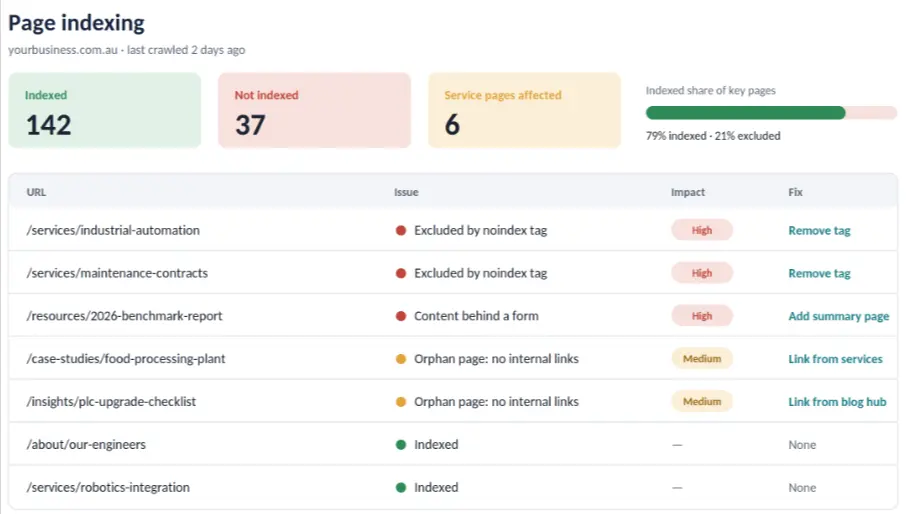
The priority is to ensure search engines can access your website and discover its key content. Internal linking supports this process by helping visitors and search engines find related pages and understand how topics connect. Important service pages should link to useful supporting content rather than remain isolated.
2. Your industry expertise makes your B2B content more valuable
Google emphasises unique, helpful content in its AI search guidance. Content that repeats widely available information has little to distinguish it from competing pages. In B2B, original research, practitioner experience, informed opinions and credible customer examples give content greater value.
Our test is simple: if readers can find the same answer across the first five Google results, what does your page add? The answer might come from client experiences, common customer mistakes or a well-supported perspective on industry developments.
This is why the first step with any client is to find the knowledge only their business has: what they have learnt from years of client work, the mistakes they see customers make, or a clear point of view on where their industry is heading.
The challenge is extracting this knowledge from busy subject matter experts. Rather than asking them to write articles, we start with conversations. A short discussion about recurring customer questions or lessons from a project can reveal valuable insights. One conversation may inform an article, website copy, a newsletter and LinkedIn content. Our team then turns that expertise into clear, readable content while keeping the client's brand voice.
In Practice: An Australian IT and business advisory firm we work with had deep expertise across its consultants but little time to write. Instead of asking them for articles, we ran monthly knowledge-sharing workshops with the leadership team and recorded short interviews with consultants about client challenges and industry trends.
We combined these insights with keyword research to create search-focused content, and tracked each article's performance to guide future topics. Since 2021, organic search traffic has increased by more than 4,800%, and traffic from 10 priority keywords ranking on Google's first page has grown by 251%.
We see this opportunity in many B2B businesses. A CEO may have 20 years of industry experience, technical specialists may solve complex customer problems every day, and sales teams may understand exactly what buyers struggle with. Yet much of this knowledge remains inside the organisation rather than appearing in its content.
Making that expertise visible is not just about improving content quality. It is also about how businesses use their people's time. This is particularly important for professional services firms, where employees' time directly contributes to billable work and business growth.
We call this Return on Effort (ROE): the value a business gets from the time and expertise its team invests in marketing. Unlike ROI, which focuses on financial returns relative to investment, ROE considers the time and effort required to achieve those returns. It is not a metric KLIQ measures, but an important consideration for businesses deciding how to use their internal resources.
For lean B2B teams, the opportunity is to turn existing knowledge into useful content without placing an unnecessary writing burden on subject matter experts. A recorded interview, for example, can provide insights for an article, newsletter and LinkedIn posts. This helps businesses make better use of their expertise while allowing their teams to focus on their core responsibilities.
Publishing articles, newsletters and social posts every month is not enough. The content must address customer needs, demonstrate genuine expertise and justify the time invested in creating it. That is where businesses should consider both their return on investment and their return on effort.
3. Covering your customers’ questions helps your business stay visible
Google's query fan-out process expands a user's question into related searches. Content may therefore be considered in the context of a broader topic, not just the exact words in the original query. Businesses that cover subjects comprehensively can provide useful information throughout a buyer's research. To find these questions, we often look beyond keyword tools to the people who speak with customers every day, such as sales, customer service or account management teams. The questions they hear regularly are often the same ones buyers are now asking AI.
Depth, however, only helps when content is clear. B2B websites often use vague claims such as "innovative solutions" without explaining what the business does or which problems it solves. We review pages to clarify what the company offers, who it serves and why its expertise matters. This is not an AI-specific trick. Clear content helps customers understand a business and gives search systems meaningful information to interpret. Our rule of thumb: if a busy customer can understand your page in 30 seconds, search engines and AI tools usually can too.
For a new client, that starts with a review of every page on the site, including service pages, blogs and case studies, and then expanding thin pages with real detail and answers to the questions customers actually ask.
4. A clear website helps buyers understand what your business offers
Descriptive page titles, meaningful headings, logical organisation and direct explanations help readers understand what a page offers. Each page should communicate its purpose without forcing visitors to work through vague claims or unnecessary detail.
Where relevant, structured data should accurately describe the visible page content. It can help search engines interpret specific information, but it does not guarantee inclusion in AI-generated answers. Accurate, well-organised content remains the priority.
Structure also supports the wider content strategy. When service pages, articles and case studies explain related aspects of a business's expertise, buyers can move naturally from understanding a problem to evaluating potential solutions. A well-planned B2B content hub brings these pages together so they support SEO, AI search and conversion at the same time.
5. Showing evidence of your expertise helps buyers trust your business
Credibility develops through genuine recognition, customer experience and evidence of expertise. Press coverage, partnerships, speaking engagements, reviews and customer advocacy can demonstrate a business's presence beyond its own website.
That credibility should be consistent wherever buyers encounter the brand. Websites should explain the problems a business solves, case studies should demonstrate real outcomes, and articles and LinkedIn content should reflect the team's expertise. Google's E-E-A-T framework is not a single ranking factor, but its emphasis on experience, expertise, authoritativeness, and trust reinforces the value of credible information. These signals do not guarantee inclusion in AI answers, but they help build buyer confidence.
Reliable citations also strengthen evidence-based content. Link to relevant primary sources, original research, and authoritative references so readers can verify claims. Citations alone do not guarantee that a search engine or AI platform will select or reference your page.
How do you measure B2B SEO and AI search visibility?
Measure SEO and AI search across the buying journey, not just rankings or traffic. AI visibility includes being cited as a source, included in comparisons or recognised as a credible option. For B2B businesses, pipeline quality and assisted conversions help show whether visibility influences purchasing decisions.
We track visibility across Google Search, Bing Search and AI Overviews, branded and non-branded queries, traffic from search engines and AI assistants, and on-site engagement.
Buyers often move between channels before enquiring. They might discover a business on Google, research a problem in ChatGPT, read a case study and visit LinkedIn before making contact. Measuring these touchpoints helps us understand how different channels contribute to conversions.
Our principle is simple: if it isn't measurable or reportable, we don't do it. Our KLIQmetrics™ dashboard brings SEO performance, AI visibility, and wider marketing results into one place. This helps us assess performance and make informed decisions.
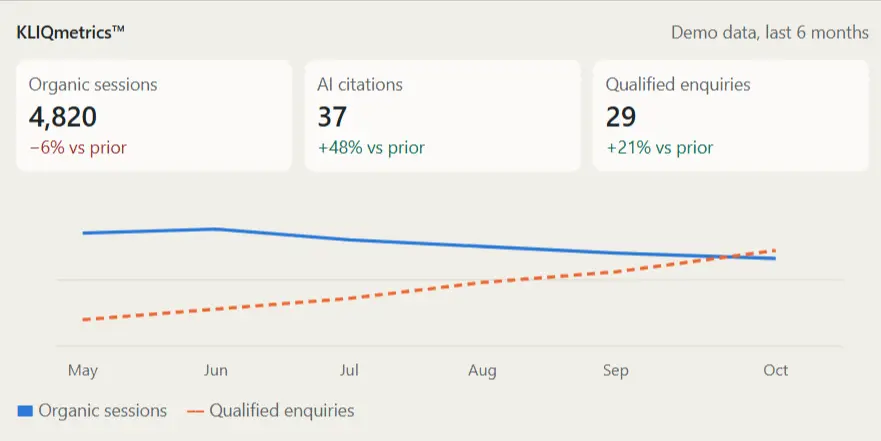
Ultimately, visibility matters only when it reaches the right audience and contributes to enquiries, qualified leads and sales opportunities. We use these results to identify what works and where the strategy needs to change.
Is your B2B SEO strategy keeping up with AI search?
AI search is changing how buyers discover and evaluate businesses, but SEO remains essential. To stay visible, B2B businesses need to demonstrate their expertise, answer customer questions and make credible information easy to find across Google and AI search platforms.
Since 2013, KLIQ has partnered with Australian B2B businesses across industries including healthcare, construction, financial services, education and superannuation. We combine technical SEO, content strategy and AI search optimisation to turn existing industry knowledge into stronger search visibility and meaningful business opportunities.
Our approach goes beyond rankings and AI citations. We focus on helping businesses reach the right buyers, build credibility and create opportunities for growth.
Understanding how your business performs across Google and AI search is the first step towards identifying visibility gaps and opportunities your competitors may already be capturing.
Get in touch with KLIQ to assess your search visibility and discover how your business can turn its expertise into stronger search visibility and measurable growth.