June 5, 2026
How to Build a B2B Content Hub That Supports SEO, AI Search, and Conversion
Share:



B2B buyers before they talk to sales, they research the problem, and explore different solutions. One blog post can’t cover that journey. A content hub can.
A content hub is a group of pages built around one topic. A central page gives a broad overview. Supporting articles go deeper into specific questions, challenges, and use cases.Everything links together, so readers can move through the topic naturally.
This structure does three things well. It helps you rank higher in search. It makes your content more visible in AI-generated answers. And it moves readers toward a sales conversation when they’re ready.
This guide will show you how to build one.
Key Takeaways
- A B2B content hub works best when it is structured around a pillar page, supported by interconnected topic clusters rather than isolated blog posts.
- Topic clusters should come from real buyer questions and intent, not just keyword tools, so your content reflects how people actually think and search.
- Strong hubs improve visibility in both traditional SEO and AI search tools by showing depth, structure, and topical authority.
- Conversion improves when each stage of the buyer journey has tailored next steps, from educational resources to demos and case studies.
- Content hubs perform long-term when they are regularly updated, internally linked, and designed to guide users from awareness to decision.
The three parts every b2b content hub needs
Here are three key parts:
- Pillar content: Main page giving a broad, complete overview of a topic your buyers care about. It acts as the entry point.
- Topic clusters: Supporting articles that each focus on a specific subtopic and link back to the pillar page.
- Conversion pathways: Clear next steps that guide readers from learning to taking action, such as contacting sales or requesting a demo.
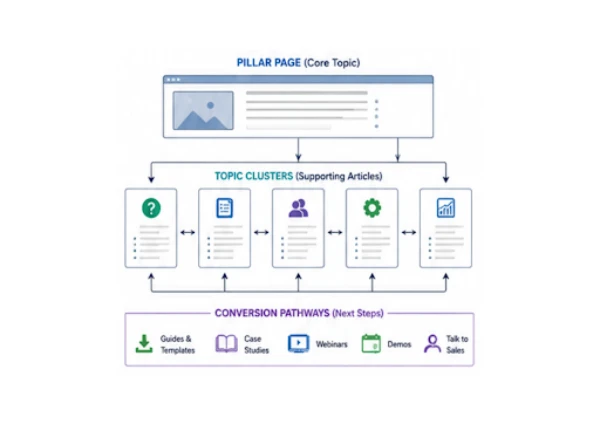
When these three parts work together, content becomes more effective and scalable. Remove one, and the system loses most of its impact.
1. Pillar Content: Your main B2B content resource
A pillar page isn't simply a long blog post; it's a comprehensive guide built around a real problem your audience is actively trying to solve. Most run between 2,500 and 4,000 words. The goal is to cover a topic broadly and authoritatively, then link out to deeper, more specific articles for readers who want to go further.
Choosing the right pillar topic
Say you sell education software to schools or training providers. You might default to something like "education software features", but that's not how your audience searches. They're not browsing for features; they're trying to fix a problem.
A stronger pillar topic would be: “How to improve student engagement in digital learning environments”.
That page would naturally cover how attention spans shift in online classrooms, the challenges teachers face with remote and blended learning, how schools measure engagement, and which tools actually move the needle on participation and outcomes.
Each of those sections then seeds its own detailed article, "Best strategies to increase participation in online classes" or "How to track student engagement in LMS platforms", all linking back to the pillar. That's the cluster model in action.
When search engines encounter a page that thoroughly covers a topic and connects to a web of related content, they read it as a signal of genuine depth and expertise. The same logic applies to AI tools like ChatGPT, Claude, and Gemini. When someone asks, "How do I keep students engaged in online learning?", these systems draw from sources that are well-structured, detailed, and clearly authoritative.
A strong pillar page gets referenced. A thin, generic article gets skipped.
2. Topic Clusters: The B2B resources that support your pillar content
If your pillar page is the hub of a wheel, your cluster articles are the spokes. Each one goes deep on a specific subtopic, targets a precise search query, and links back to the pillar. They often cross-link to each other, too.
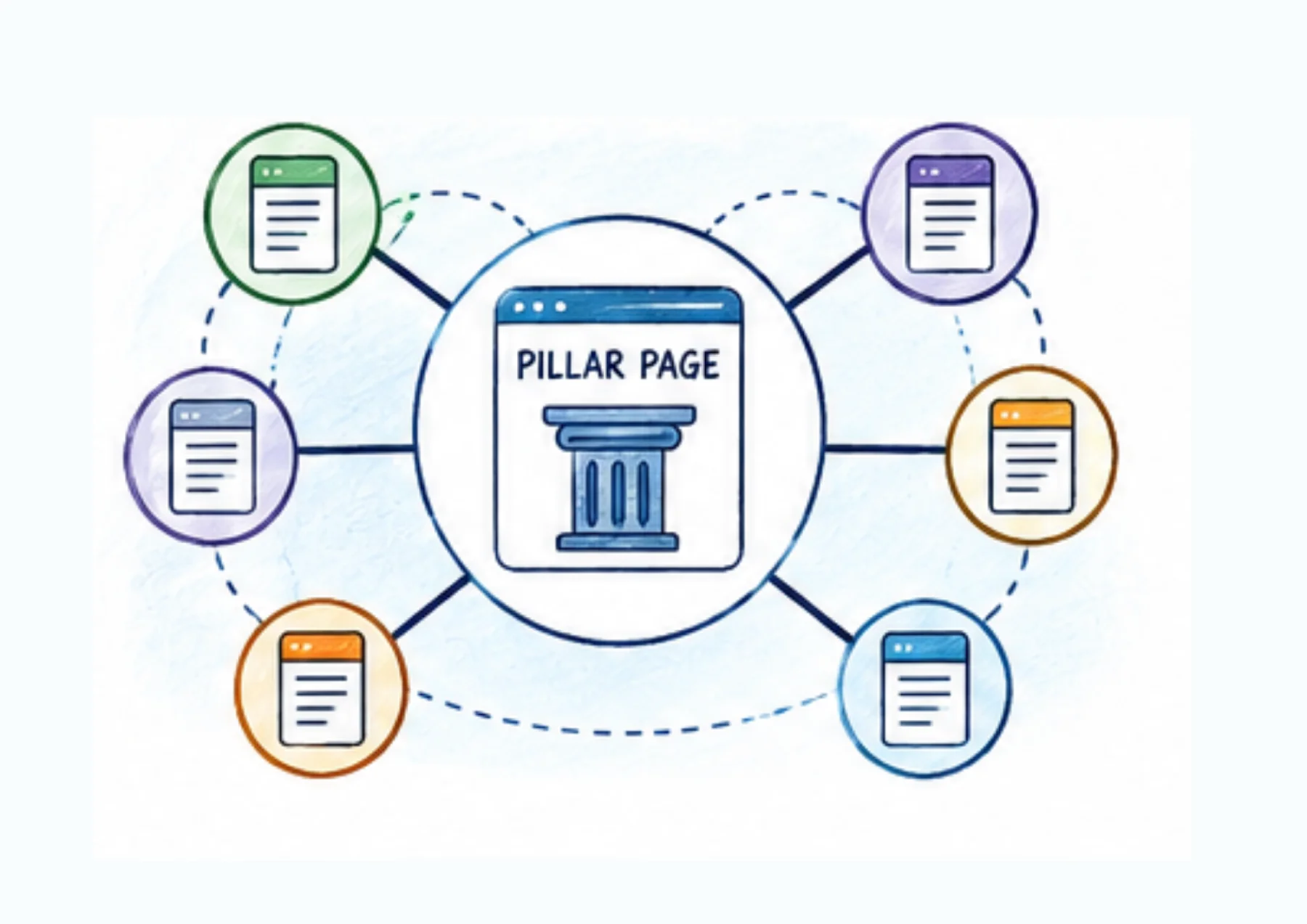
One cluster article on its own might perform modestly. But 15 articles all linking back to the same pillar, with cross-links between related pieces, creates something much harder for competitors to replicate.
At KLIQ, we often see this shift happen when B2B companies move away from publishing isolated campaign content and instead build structured topic ecosystems around high-value industry themes. In many cases, the strongest traffic growth comes not from the pillar page itself, but from the cumulative visibility of highly specific cluster articles targeting implementation and comparison-based searches.
a) How to choose cluster topics
Don't start with a keyword tool. Start with your buyers' questions.
Go back through your last 20 sales calls, support tickets, and live chat transcripts. The questions that come up again and again before someone buys, during onboarding, and when something goes wrong are your cluster topics.
For example, let’s use a cybersecurity software or services company, which might include:
- "How do I know if my business has already been breached?"
- "What's the difference between a vulnerability assessment and a penetration test?"
- "Do we need cyber insurance, and what does it actually cover?"
- "How do I explain our security posture to the board without losing them?"
- "What compliance framework applies to us (SOC 2, ISO 27001, or NIST?)"
Keyword research comes second. Its job is to confirm that people are searching for those questions and to show you how they phrase them online.
Buyers often describe a problem one way in conversation and search for it quite differently. A CISO might ask your sales rep, "How do we reduce our attack surface?" but type "network segmentation best practices for enterprise" into Google. You need to understand both.
b) How many cluster articles do you need?
A starter hub can launch with 8 to 10 cluster articles. A mature hub should aim for 15 to 25 per pillar topic. That reflects the real complexity of B2B buying decisions and is what's needed to compete for topical authority in most categories. If producing at that volume feels like a stretch, see how to scale your B2B content team with AI and human processes without sacrificing quality.
c) The three types of cluster articles that matter most
Not all cluster content serves the same purpose. The three core types each target a distinct stage of the user journey, and together they form a complete content strategy that attracts, educates, and converts.
i) Informational Clusters
Informational clusters explain concepts, definitions, and foundational ideas, the "what" and "why" content that draws in broad audiences. In an HR software context, this includes articles like What is an employment contract and what should it include?, What is employee onboarding, and why is it important? What is HR compliance, and how does it affect small businesses?
This type of content builds trust and establishes topical authority. Because it answers questions people ask at the very start of their research, it generates steady organic traffic over time and introduces your brand to readers who may not yet know what solution they need.
ii) Comparison Clusters
Comparison clusters serve users who are actively weighing their options before making a decision. These articles help readers evaluate tools, approaches, or platforms side by side, for example,
HR software vs spreadsheets for managing employee leave, Best HR platforms for businesses under 50 employees, or BambooHR vs Workday: which is better for small teams?
Because these readers are already shortlisting solutions, comparison content targets high-intent traffic. Users arriving here are closer to a decision, which makes this cluster type particularly strong for driving conversions.
iii) How-To / Implementation Clusters
How-to clusters are step-by-step execution guides built around solving a specific, real-world task. Examples include How to set up an employee onboarding process step by step, How to run a performance review cycle in a small business, and How to automate employee leave tracking in HR systems.
This content meets users at the moment they are ready to act. Because the reader already knows what they want and is looking for guidance on execution, how-to articles tend to attract the highest-quality leads and often produce the strongest conversion outcomes of the three cluster types.
d) How to structure B2B content for humans and AI
Your B2B content now needs to work for two audiences at once: real people searching for answers, and AI systems deciding which sources to reference in their responses.
Building a deliberate AI search optimisation strategy into your content structure, not as an afterthought, but from the start, is what separates hubs that get cited by AI tools from those that don't.
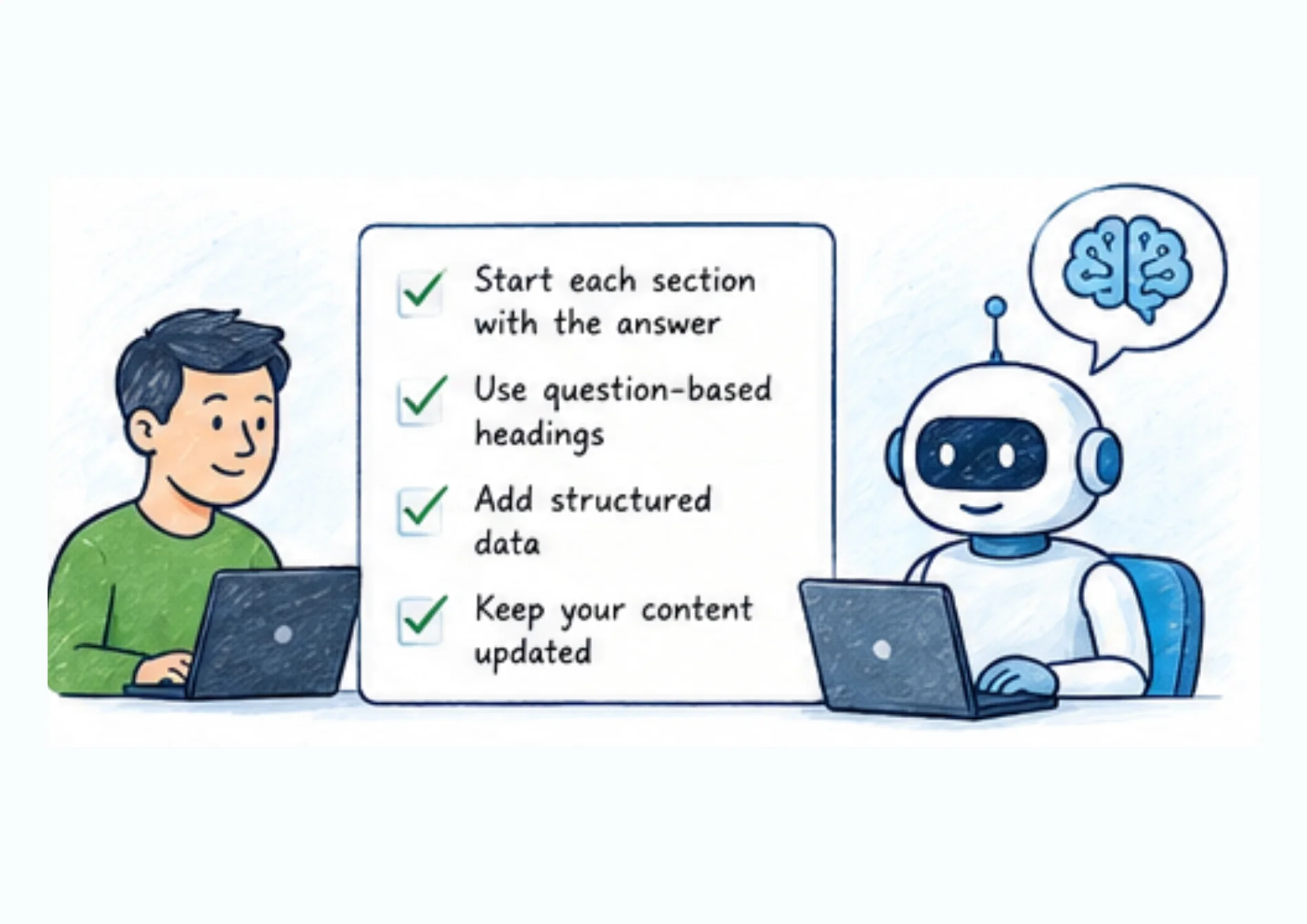
If your content is poorly organised or lacks depth, it won't appear in AI-generated answers, no matter how well you've chosen your topic.
This is especially important for SMEs competing with larger brands that have bigger content budgets. We increasingly see AI search tools prioritise content that is clearer, better structured, and more directly aligned with buyer questions rather than simply favouring the largest website in a category.
For smaller B2B teams, this creates an opportunity to compete through depth, specificity, and strategic content architecture rather than publishing volume alone.
1. Start each section with the answer
Don't bury the main point. Open every section with a clear, direct statement of what the reader is about to learn.
- Weak opening: "There are various things construction businesses need to think about when managing compliance across multiple active sites."
- Stronger opening: "Managing site safety and compliance manually becomes unsustainable once you're running more than two or three projects simultaneously. At that point, most construction businesses need a structured system to track permits, inspections, and subcontractor documentation."
The second version gets straight to the point. That's easier for a reader to absorb and easier for an AI tool to extract and surface in response to a relevant question.
2. Use Question-Based Headings
Questions mirror how buyers actually search, especially in AI tools, where people type full sentences rather than short keywords. For a construction services company, that means headings like:
- "What permits do I need before breaking ground on a commercial build?"
- "How do I manage subcontractor insurance and compliance documentation?"
- "When does a construction project require a dedicated site safety officer?"
This structure helps AI systems match your content to the exact questions buyers are asking, whether that's a property developer scoping a new project or a facilities manager evaluating contractors and improves your chances of being the source they reference.
3. Add structured data
Structured data is code added to your pages that helps search engines and AI systems understand what type of content they're looking at. Most CMS platforms support it through plugins. For B2B content, the most useful types are:
- FAQ schema for question-and-answer sections
- HowTo schema for step-by-step guides
- Article schema for blog posts and long-form guides
- Organisation schema for your company pages
4. Keep your content updated
Publishing new articles isn't enough. Your highest-performing pages need to stay current, especially if they reference legislation, employment standards, or industry figures that change over time.
Outdated information damages your credibility and drops your rankings. Build a simple process to review and refresh your top pages at least once or twice a year.
3. Conversion Pathways: Turning traffic into B2B leads
A lot of content strategies do a good job bringing in traffic but fall short when it comes to turning that traffic into leads. This is where a well-built content hub for lead generation becomes different from a blog. Every piece of content has a deliberate next step built around where the reader actually is in their decision process.
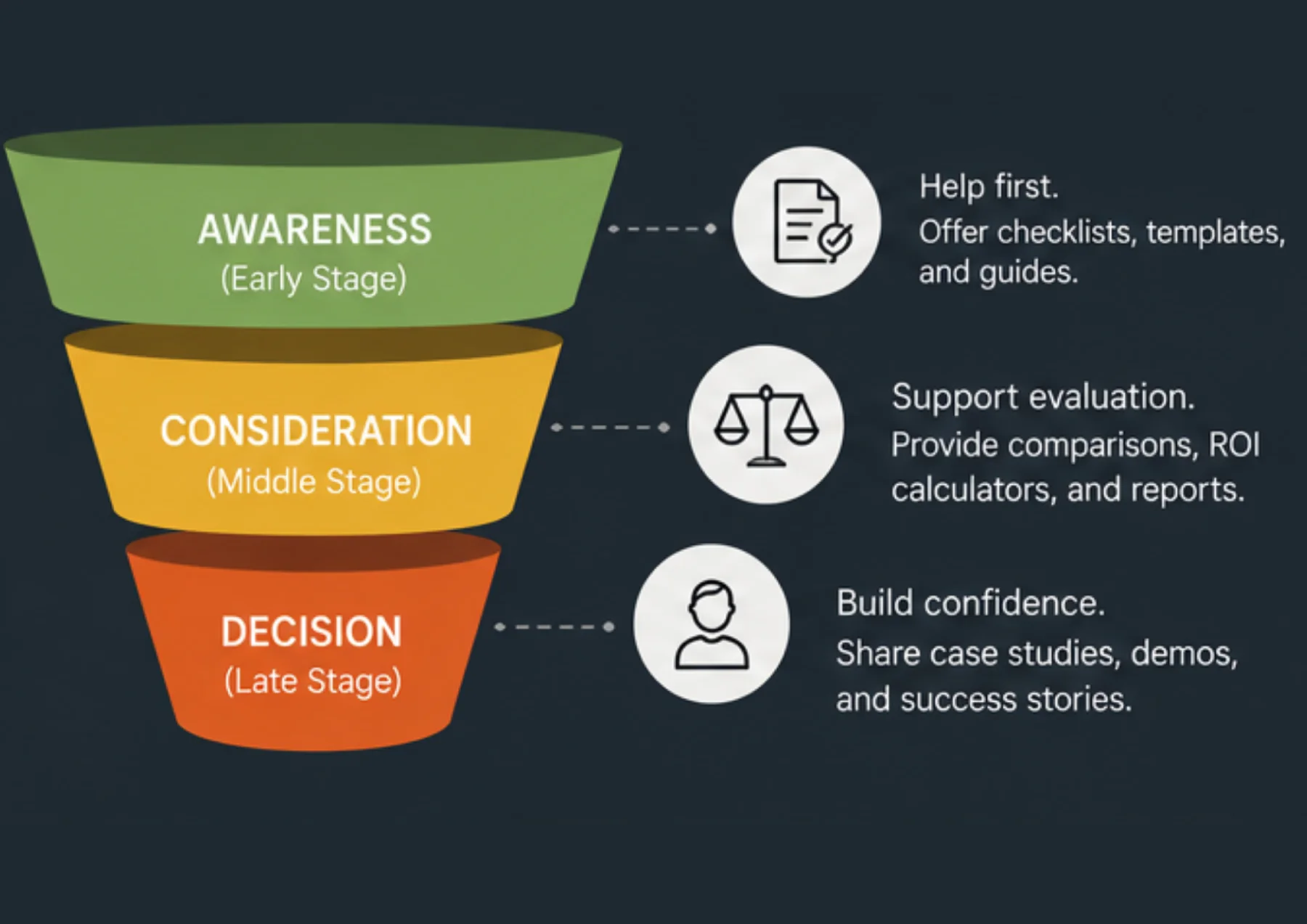
Most people arriving through search are still figuring things out. Your call-to-action has to match where they are in the decision process, not where you want them to be.
1. Early stage: focus on helping, not selling
The reader is trying to understand their problem, not yet evaluating vendors. A demo request feels like too much, too soon. What works better is useful, and easy to access:
- Checklists
- Templates
- Short guides
- Worksheets
For example, if someone is reading “Common freight invoicing errors that increase logistics costs”, a better next step than a demo is:
“Download a freight cost leakage audit checklist for logistics operations.”
It fits the mindset. It helps first, and it starts the relationship without pressure.
2. Middle stage: support evaluation and comparison
Now the reader understands the problem and is actively looking at solutions. More detailed, decision-support content performs better here:
- Comparison guides
- ROI calculators
- Benchmark reports
- Webinars
For example, someone reading "accounting software vs hiring a bookkeeper" is clearly weighing trade-offs.
A useful next step could be a practical guide like "How to Automate Your Invoicing and Monthly Reporting Without Hiring Additional Staff." This type of content helps the reader understand the process, expected outcomes, and operational impact, while moving them closer to a confident decision.
3. Late stage: build confidence and reduce doubt
At this point, the reader is close to making a decision. They don't need more education; they need reassurance that they're choosing the right option. This is where trust-building assets matter most:
- Case studies
- Product demos
- Free consultations
- Customer success stories
For example: share a case study like: "See how a 12-person architecture firm reduced its monthly close from five days to one using this platform."
That kind of message doesn't just inform. It proves value in a real-world context.
Build a content hub to support your B2B content strategy to drive conversions
A structured content hub works better. Pillar pages build authority, topic clusters answer specific buyer questions, and clear conversion paths turn interest into leads. When content is built for both people and AI systems, it continues to drive value long after publication.
In short, it becomes a long-term asset that supports consistent growth and stronger visibility in modern search.
At KLIQ, we partner with B2B marketing teams across HR, IT, professional services, energy, healthcare, SaaS, local government, and education to build content strategies that are practical, scalable, and tied to real business goals.
We don't just deliver a playbook, we co-create the strategy and support execution. Our team combines expertise in content, SEO, and B2B strategy with hands-on experience, helping teams integrate AI into their workflows through smarter editorial processes and AI masterclasses that improve confidence and productivity.
In our experience, we consistently see the same pattern: businesses that structure their content around buyer intent and interconnected topic authority achieve stronger long-term organic visibility than those relying solely on disconnected campaign content. That becomes even more important as AI search tools increasingly prioritise depth, clarity, and source credibility when surfacing answers.
If you’re ready to turn your content into a structured growth system that builds authority, attracts the right buyers, and performs in both traditional and AI-driven search, connect with our B2B SEO experts at KLIQ.
We’ll help you shape a strategy that’s built for long-term visibility and real business impact.
FAQs
A B2B content hub is a group of pages built around one core topic. A central pillar page gives a broad overview, while supporting cluster articles go deeper into specific questions, all linked together so readers and search engines can navigate the topic naturally.
A SEO content hub needs pillar content, a comprehensive page covering a broad topic, topic clusters, supporting articles on specific subtopics linking back to the pillar, and conversion pathways, clear next steps like guides or demos that move readers towards a sales conversation.
Most effective B2B pillar pages run between 2,500 and 4,000 words. For B2B marketing content, the goal is to cover a topic broadly and authoritatively, then link out to deeper, more specific cluster articles for readers who want to explore a particular angle further.
A starter content hub can launch with 8 to 10 cluster articles, while a mature hub should aim for 15 to 25 articles per pillar topic. This reflects the real complexity of B2B buying decisions and helps build genuine topical authority in a category.
KLIQ builds B2B content clusters around three core types: informational, which explain concepts and build trust, comparison, which help buyers evaluate options and drive high intent traffic, and how to or implementation guides, which meet buyers ready to act and typically produce the strongest conversion outcomes.
KLIQ starts with real buyer questions rather than a keyword tool. We review recent sales calls, support tickets and live chat transcripts for the questions that come up again and again, then use keyword research to confirm search volume and how B2B buyers actually phrase those questions online.
KLIQ structures B2B content by starting each section with a direct answer, using question based headings that mirror how buyers search, and adding structured data such as FAQ, HowTo and Organisation schema. This helps AI systems like Google, ChatGPT, Claude and Gemini quickly find and cite the content. See KLIQ's guide on generative AI search: https://kliqinteractive.com/insights/seo-optimise-b2b-website-for-generative-ai-google-search/
In KLIQ's content hub framework, a conversion pathway is the next step offered to a reader based on where they sit in the B2B buying journey, checklists or templates for early stage awareness, comparison guides or ROI calculators for consideration, and case studies or demos for decision stage.
High performing pillar and cluster pages should be reviewed and refreshed at least once or twice a year, particularly if they reference legislation, industry figures or standards that change over time. Outdated B2B content damages credibility and can cause rankings to drop.
A single blog post cannot cover the full B2B buyer journey. As a B2B content marketing agency, KLIQ builds content hubs that connect a pillar page with many supporting articles and clear conversion pathways, signalling topical authority to search engines and AI tools while guiding readers towards a sales conversation.