October 14, 2026
How B2B Marketing Leaders Can Improve AI Search Visibility and Get Found by Buyers
Share:



Your next big customer may have never found you and never added you to their consideration list/shortlist, and you will never know.
It happened in a chat window. A finance director asks ChatGPT, "Which payroll providers suit Australian firms with 200 staff?" She gets five names and calls three. If you were not on that list, you never had a chance.
AI is now part of how B2B buyers research their options before they speak to sales. You do not need to write for robots to make the list. You need a connected body of evidence that shows people and AI what your business knows, does and can prove.
At KLIQ, we help B2B businesses get found through SEO, content and digital strategy. Working with clients through the rise of AI search has taught us that visibility is not a separate content exercise. It comes from a wider system of customer usefulness, expertise, authority and evidence.
This guide shares what we have learned, so you can build that system for your own business.
Key Takeaways
- Make content useful for people first, then optimise it for AI and search.
- Answer buyer questions directly with clear, self-contained sections and answer blocks.
- Use technical SEO, schema and site structure to help AI understand your content accurately.
- Build authority beyond your website by connecting expertise across LinkedIn, media, video and other trusted channels.
- Measure AI visibility alongside qualified traffic, branded searches, engagement and assisted conversions.
Why is AI search becoming part of the B2B buying journey?
AI search shapes your pipeline because buyers now use AI tools to research companies, problems and potential solutions before they speak to a salesperson. In 2025, data shows that 94% of B2B buying groups use generative AI for research before they speak to a salesperson.
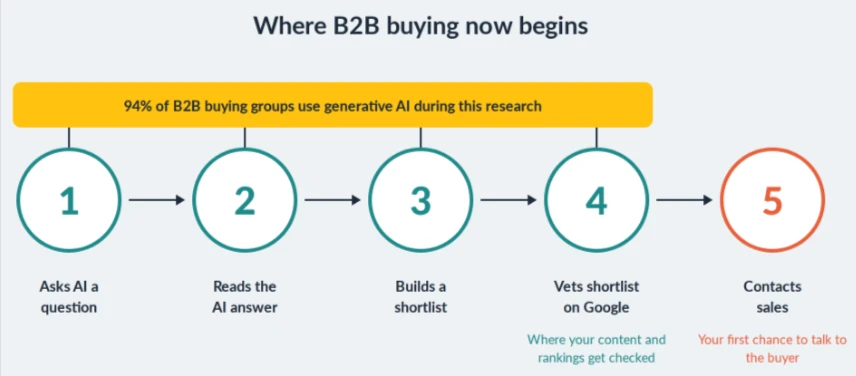
This shift is also changing how people discover information. Gartner predicted that search engine volume would fall by 25% by 2026 as people turned to AI chatbots. LinkedIn found that some of its own awareness keywords lost up to 60% of their traffic after Google launched AI Overviews.
These figures point to a broader change in how people find and research information. The exact impact will vary by market, search behaviour and query type, but the direction is clear: some of the research that once happened through traditional search is now happening inside AI interfaces.
Fewer clicks are only part of the problem. The bigger issue is whether your business appears when a potential buyer asks an AI tool who they should consider, what options exist or how to solve a particular problem. That is why B2B leaders need to rethink SEO, discoverability and their wider B2B marketing strategy in the age of AI search.
Our advice is simple: do not treat AI search as a separate channel. It is part of your wider visibility and reputation. So stop asking only, "Do we rank on Google?" Start asking, "Are we one of the trusted names buyers and AI tools can find when they research our market?"
What are B2B marketing teams getting wrong about AI search?
The biggest mistake we see is putting too much attention on how to optimise for AI while overlooking why the content exists in the first place: to help a real buyer make a decision. Before thinking about schema, structure, or other technical signals, teams need to understand who they are trying to reach, what those buyers care about, and which questions they need answered.
That starts with understanding your audience. What problems are buyers trying to solve? What concerns could stop them from choosing you? What information do they need before they will trust your business? A strong content plan should come from these questions, creating useful and educational content that helps buyers understand their challenges, explore their options, and make informed decisions.
This also means looking beyond obvious keywords. Buyers may search for solutions differently at different stages of their journey. They might start by trying to understand a problem, then compare approaches, evaluate providers, and look for evidence that a business can deliver. Your content should reflect those needs rather than simply target a list of search terms.
AI visibility cannot compensate for a poor customer experience. A buyer may discover your website through an AI-generated answer, but if they cannot quickly understand what you offer, who you help, or why your business is credible, that visibility has little commercial value.
We also see websites filled with AI-generated copy that says plenty but demonstrates very little. The content may contain relevant keywords, yet lack the experience, insight, and evidence that make it genuinely useful to a buyer.
Our principle is simple: make content valuable to people first, then make it easier for machines to understand. Be clear about what you do, who you serve, and the problems you solve. Answer the questions customers genuinely ask, and demonstrate expertise through real experience and evidence.
Once that foundation is right, SEO, technical SEO, schema, and clear site structure can help search engines and AI platforms understand and surface the content. These elements should support a content strategy built around real buyer needs, not determine what you publish in the first place.
For more on finding the right balance between AI efficiency and human expertise, read AI vs human copywriting: benefits and pitfalls for B2B teams.
How should B2B marketers create content that AI can understand?
Write content in short, self-contained sections that answer one question at a time. AI tools rarely use an entire page. They often pull a sentence or short passage from a page, sometimes without the surrounding context. Each section should therefore make sense on its own.
This is one of the biggest changes we have made to our own writing. Traditional SEO content is often built towards an answer, revealing the main point after several paragraphs. For AI search, the answer needs to come first, followed by the detail that supports it.
A few writing habits make this easier:
- Write complete, direct sentences. “Helps grow pipeline” says very little. “Our lead generation campaigns increase qualified sales opportunities” gives AI a clear statement to understand and potentially cite.
- Keep sentences concise. Shorter sentences are easier for both people and AI systems to understand.
- Use an expert, neutral tone. Write like a trusted source sharing useful information, not an advert trying to make a sale.
- Use specific facts. “The campaign was a rocket ship” adds little meaning. “The campaign increased qualified leads by 20%” gives AI something concrete to understand and cite.
- Explain ideas as you introduce them. Add a brief definition, reason or example so each passage remains useful when separated from the rest of the page.
- Make the logic explicit. Words such as “because”, “so” and “for example” help connect ideas and make the relationship between them clearer.
What are answer blocks, and how should you write headings?
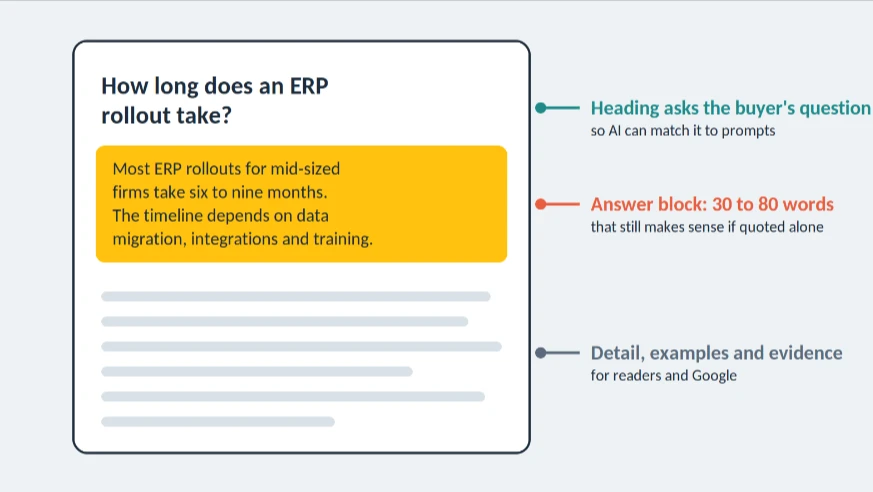
An answer block is a short, direct answer of 30 to 80 words that appears at the start of a section. It answers the question in the heading immediately, before adding supporting detail. This format works well because it mirrors how people phrase questions in AI search.
We use answer blocks frequently in FAQs, where each answer is usually 40 to 60 words and makes sense on its own. We now apply the same approach to full articles: write the heading as a question a buyer or AI tool might ask, then answer it in the first sentence.
For example, under the heading “How long does an ERP rollout take?”, start with: “Most ERP rollouts for mid-sized firms take six to nine months.”
Then explain the stages, risks, and examples in the paragraphs that follow. This gives AI tools a clear answer to extract while giving readers and Google the depth they need.
Headings should also create a logical structure, moving from the broad topic in the H1 to more specific sections in H2s and H3s. For a quick check, use a free browser extension such as HeadingsMap to view the page’s heading structure at a glance.
Which technical changes help AI understand your website?
Technical SEO still matters. It helps search engines and other systems access, interpret, and connect your information. But it works best when the content underneath is already clear and useful.
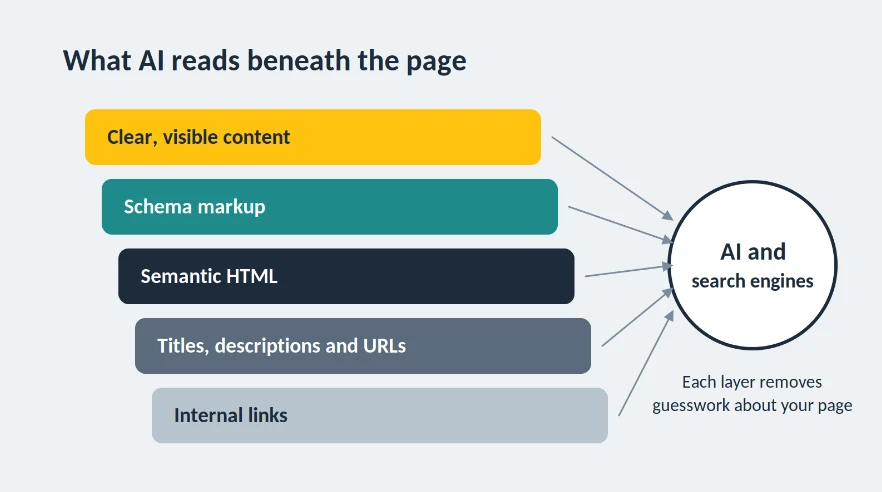
- Schema markup: Schema is hidden code that labels your content, such as "this is a question", "this is the author," or "this is our company". It tells search engines what a page contains and how the entities on your site connect. Use it only where it accurately describes what visitors can see, not because you hope it will boost AI visibility.Pair the Article schema with clear author and publication details. Add Organization schema linking to trusted profiles, such as your LinkedIn company page.
- Semantic HTML: Tags such as article, section, and aside show what each part of a page does. Keep key text visible, not hidden in pop-ups or loaded by scripts. Accessibility and machine readability share one principle: make important information clear and easy to follow.
- Page titles, descriptions, and URLs: Write titles the way buyers ask questions, such as "How to Choose a Payroll Provider". Use full words in URLs: /how-to-choose-a-payroll-provider, not /svc-pr-01. Write meta descriptions that summarise the page accurately instead of repeating keywords.
- Internal links and updates: Use clear link text such as "See our CRM pricing guide", not "click here", and link pages only where it helps the reader. Keep key pages within two clicks of your homepage, where it makes sense. Show a "last updated" date and review pages regularly, especially those covering statistics, regulations, or products.
How do images, videos and PDFs affect your AI visibility?
AI systems use the text and structured information available around media to understand its context. Clear alt text, file names, captions, transcripts, and structured data can help both users and search systems understand your media.
- Images: Describe what each image shows. "Diagram showing the stages of the B2B sales funnel" works far better than "image1". Name files clearly too: sales-funnel-stages.png, not IMG_4021.png.
- Video: Give every video a clear title and description. Add a full transcript where appropriate and VideoObject schema. Embed your YouTube videos on relevant pages using the standard YouTube player. Compress videos so they do not slow your page down.
- PDFs: Many B2B firms hide their best thinking in PDF reports. A PDF should contain real, selectable text, not scanned images. Give it clear headings, a sensible file name and a small file size. Better still, publish the main content as a web page and offer the PDF as an extra download.
Why does AI visibility go beyond your website?
This is where AI search changes the conversation. Your website is important, but it is only one part of the evidence buyers and AI systems can encounter about your business.
AI visibility is not just a website or SEO task. Your authority becomes stronger when your expertise is consistently demonstrated across the places where buyers research and validate companies. That could include your website, LinkedIn, YouTube, industry publications, partner sites, podcasts and other credible sources. LinkedIn matters, but it works best as one part of a wider B2B authority system, not a standalone AI search tactic.
This means you need to break down the walls between SEO, content, PR, social media and demand generation. These channels can reinforce each other when they are built around the same areas of genuine expertise.
For example, one original survey of 300 HR directors could become:
- a detailed guide on your website
- a series of LinkedIn posts
- comments from your CEO in the trade press
- a short video
- sales material built around the findings
- evidence that reinforces your expertise when buyers research the topic through AI
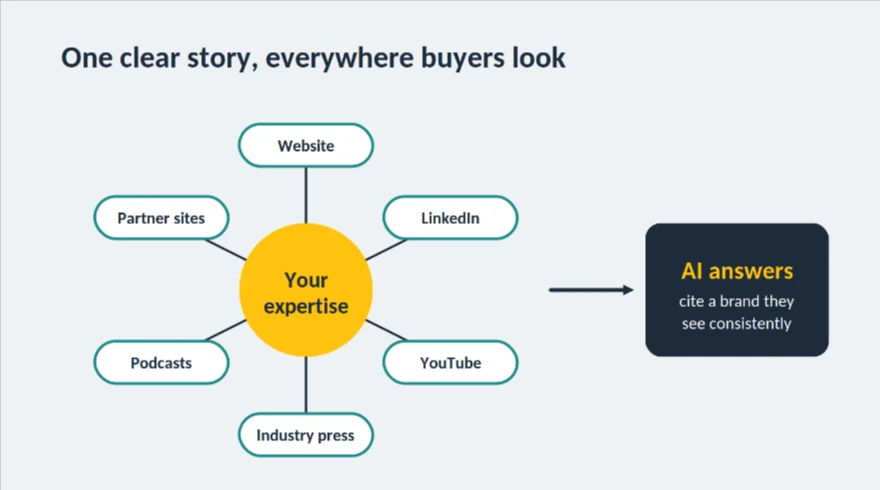
The point is not to publish the same idea everywhere. It is to create a connected body of evidence that shows your business understands a particular problem and has something useful to say about it.
The formats that work best answer the questions senior buyers put to AI tools: detailed guides, FAQs, case studies, comparison pages, original research and expert commentary. Generic articles written only to target keywords rarely earn the same trust.
Show real experience and credibility. Name your authors and experts. Share customer evidence and your own data. Google calls these qualities E-E-A-T: experience, expertise, authoritativeness and trustworthiness.
What should B2B marketing leaders prioritise with their team?
Most B2B businesses already have valuable expertise inside the organisation. The challenge is making that knowledge visible in a way that helps buyers understand the business and gives search engines and AI platforms useful evidence to work with.
That expertise can sit with your CEO, sales team, technical specialists, customer service staff or people who have spent years solving customer problems. Rather than asking these people to write content themselves, bring their knowledge into the content process through focused conversations.
A 45-minute discussion with a technical leader, for example, can provide insights for articles, case studies, guides, LinkedIn content, and sales material.
We have seen the impact of this approach with a leading Australian HR technology business, where we worked closely with the internal team to turn its existing expertise and industry knowledge into useful, authoritative website content. Over time, this helped strengthen its performance in traditional search while also increasing visibility through AI assistants, with AI-assistant website traffic growing by 233%.
The wider value goes beyond individual articles. When genuine expertise is consistently reflected across a website and other channels, it can strengthen how a business is understood and trusted across search, social platforms, third-party publications and AI-generated answers.
How to measure b2b content performance beyond traffic and leads
Content should not be judged only by how much traffic or how many leads a single article generates. B2B buyers often interact with several pieces of content before they are ready to speak to a business.
A buyer might discover a guide, return through another article, see an expert on LinkedIn, read a case study and eventually become part of an opportunity. That makes content's role broader than generating immediate conversions. It should help the right buyers understand your expertise, build confidence in your business and move closer to a decision.
The metrics you track should reflect that journey. Depending on the business, useful signals can include branded search growth, qualified organic traffic, AI visibility, engagement with expert-led content, assisted conversions and the role content plays in opportunities that eventually close.
Turn your B2B expertise into Google and AI search visibility
AI search visibility starts with expertise businesses already have. The challenge is making that knowledge clear, useful and credible enough for buyers, Google and AI platforms to understand.
At KLIQ, we do not see AI search as a reason to produce more generic content. We work with Australian B2B businesses to uncover the knowledge within their teams, from how they solve customer problems to the experience that sets them apart, and turn it into useful website content. We strengthen that foundation through ongoing content creation and technical SEO.
As early adopters of AI search, we have applied what we have learned across our clients’ websites. Through this work, we are seeing clients gain increasing visibility in AI-generated answers alongside their traditional search performance.
That visibility has a commercial impact. When a prospect uses AI to research potential providers, the businesses that appear can become part of the shortlist. If your competitors appear while your business does not, you may lose the opportunity before the buyer reaches your website or sales team.
The goal is not simply to appear in AI answers. It is to make your expertise credible enough to earn visibility and useful enough to keep your business in consideration. Talk to KLIQ about your SEO & AI search visibility strategy.