September 28, 2026
LinkedIn Is Not Your AI Search Strategy: It Is One Part of Your B2B Authority System
Share:



Your business can have a strong LinkedIn presence, publish consistently, and invest heavily in SEO, yet still be difficult for buyers to find or understand in AI search.
That is because AI search does not look at your LinkedIn profile, website, or content in isolation. It draws information from multiple sources to form a picture of what your business does, what it is known for, and whether its expertise is supported by credible evidence.
This matters as buyers increasingly use tools like ChatGPT and Perplexity to research potential suppliers. A recent survey found that 69% of B2B buyers use AI tools at some point in the buying process. A prospect may now encounter an AI-generated view of your business before they visit your website, read your content, or speak with your sales team.
For B2B marketers, the challenge is no longer simply creating more content or increasing visibility on individual channels. The bigger opportunity is making the expertise already inside the business clear, attributable, and consistently reinforced wherever buyers and AI search look.
At KLIQ, we see this as a shift from content visibility to authority. LinkedIn plays an important role, but it becomes more valuable when it connects with company content, employee expertise, website evidence, earned mentions, and the questions buyers are actually asking.
Key Takeaways
- LinkedIn is part of an AI search strategy, not the whole strategy. Its value grows when it reinforces expertise across other channels.
- AI search looks beyond individual content. It draws from websites, employee profiles, publications, and other sources to understand a business.
- First-hand expertise matters more as AI content grows. Real experience and evidence make content more distinctive and credible.
- B2B expertise should connect across channels. Website content, LinkedIn, case studies, earned mentions, and buyer demand should reinforce each other.
- Authority audits should examine connections, not just channels. Strong individual assets can still leave gaps when they do not support each other.
Why LinkedIn matters for AI search, but is not the whole strategy
LinkedIn gives B2B companies another place to demonstrate expertise, but posting more often does not automatically make a business more authoritative.
Its real value is connecting expertise to the people behind it. A post from a technical leader, for example, can show buyers who has the experience behind a company's claims.
That signal becomes stronger when the same expertise appears on the company website, is supported by specific projects or results, and is reinforced by credible third-party sources.
A LinkedIn post can show that someone has something to say. The wider evidence can show why that person has something worth listening to.
That's why we don't treat LinkedIn as a standalone AI search tactic. We see it as one part of a connected authority system that brings together people, company content, evidence, search visibility, and third-party recognition.
How AI search understands business expertise
AI search does not rely on a single source to understand a business. It builds its understanding from information found across the web, looking for consistent signals that connect a company with a particular area of expertise.
We think about these signals as a connected authority system, similar to how we approach building a B2B content hub that supports SEO, AI search, and conversion. It's the same thinking that shapes our work as a B2B content marketing agency: individual assets matter less than how consistently they reinforce one another.
That system can include:
- Company content: Your website and blog, where your expertise is explained in depth.
- Employee expertise: Named people whose professional experience and LinkedIn activity demonstrate their knowledge.
- Website evidence: Case studies, projects, results, and other specific proof of that expertise.
- Earned mentions: Press, partners, and industry publications that reference the business and its work.
- Buyer demand: The questions and topics customers are actually searching for.
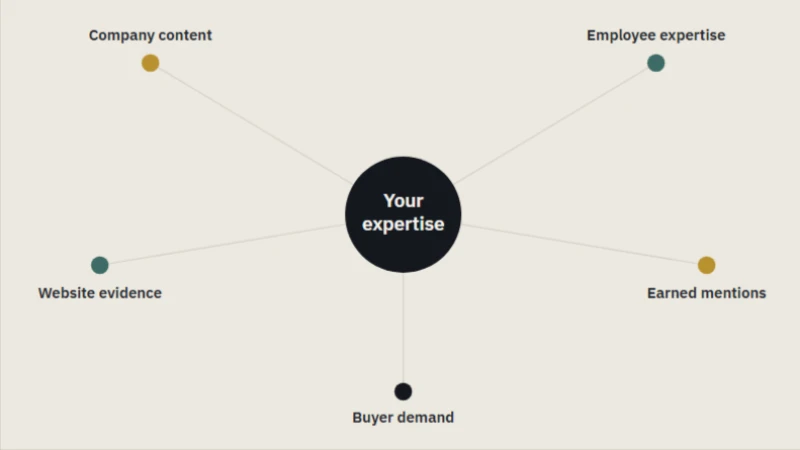
The point is not simply to have more content across more channels. The sources need to reinforce each other. A technical article becomes more meaningful when it connects to the people who have that expertise, the projects that demonstrate it, and credible external sources that recognise it.
That is what turns separate content assets into a coherent picture of business expertise, giving AI search more consistent evidence to draw from when buyers research a company or its area of expertise.
Why first-hand expertise matters as AI content grows
AI has made competent B2B content easier to produce. That makes first-hand expertise more valuable.
AI can research topics, structure articles, and produce drafts, but it can easily reproduce generic information. What is harder to replicate is the knowledge of someone who has actually solved the problem being discussed.
That knowledge often sits with operations managers, technical leads, sales teams, and subject-matter experts. They understand how things work in practice, the questions customers ask, and the details that rarely appear in standard marketing content.
For many B2B businesses, the expertise already exists. The challenge is capturing that knowledge and turning it into content that demonstrates genuine experience.
One of our clients, an Australian technology advisory and IT consulting business working across banking, superannuation and local government, is a good example. The business had significant expertise within its leadership and consulting teams, but limited time to turn that knowledge into valuable marketing content.
KLIQ helped uncover that expertise and turn it into a structured content strategy, combining genuine industry knowledge with an understanding of what their target audiences were actively searching for and interested in.
The result was content built around real expertise rather than simply creating content for the sake of being visible. Over time, this contributed to a 4,806% increase in organic search traffic, alongside significant improvements in priority keyword visibility and LinkedIn growth. The full case study shows how that expertise translated into measurable B2B growth.
What this demonstrates is that the opportunity is not simply to create more content. It is to find a way to extract the knowledge already sitting inside the organisation and turn it into useful, evidence-based content.
This is where LinkedIn can play an important role. When an expert shares their experience, the business becomes associated with a real person and a recognisable source of knowledge. When that expertise also appears throughout the company's website and is supported by evidence, it becomes part of a stronger system of authority.
Why B2B businesses struggle to turn expertise into valuable content
From our experience, the problem is rarely a lack of expertise. It is access to the people who have it.
CEOs, sales teams, and technical specialists are busy making decisions, serving customers, and solving problems. Asking them to "send ten points for a blog" rarely captures what makes their knowledge valuable.
A better approach is to extract the thinking behind their experience through interviews, conversations, voice notes, or other formats that let them explain real problems in their own words.
One conversation can then inform several pieces of content.
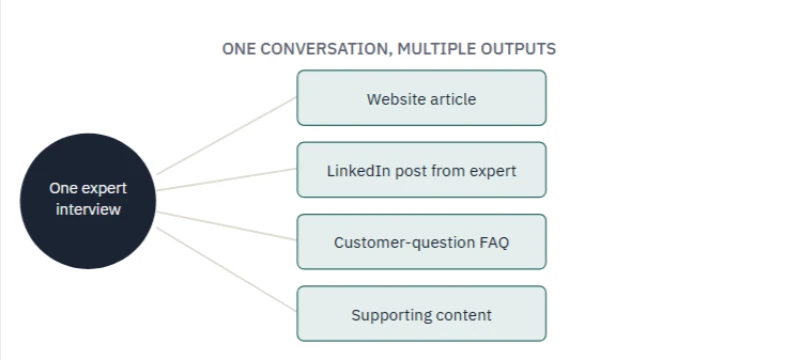
An interview with a technical expert could become a website article, a LinkedIn post from that expert, an FAQ based on a recurring customer question, and supporting content around the same topic.
The benefit is not just producing more content from one conversation. It is keeping the same first-hand expertise consistent across the authority system.
Auditing your authority system, not just your content calendar
A traditional content audit might ask whether the website is optimised, whether employees are active on LinkedIn, or whether the company has enough case studies.
Those questions matter, but they do not show whether the different signals reinforce each other.
At KLIQ, we look for the gaps between them. Does the expertise published by the company connect to the people who have that knowledge? Do those experts reinforce the same ideas on LinkedIn? Does the website provide evidence for the claims being made? Are independent sources validating those areas of expertise? And does the content address the questions buyers are actually asking?
This approach can reveal gaps that a channel-by-channel audit misses.
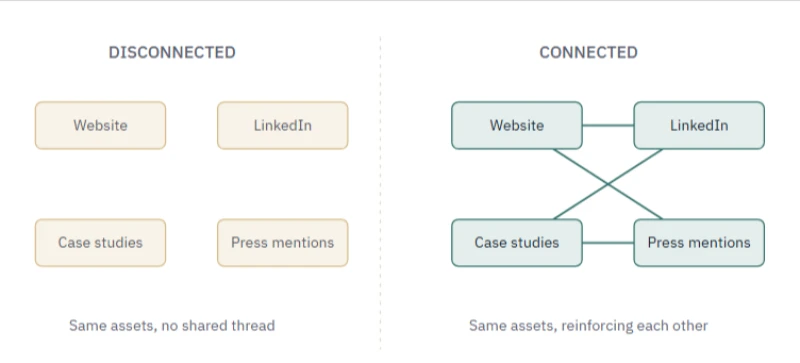
For example, a company might have strong technical content but little connection between that content and the specialists who created the underlying knowledge. Another might have active executives on LinkedIn but little evidence on the website to support their claims.
These are not simply content gaps. There are gaps between the signals that make a company's expertise easier to understand.
What this means for the future of b2b visibility
AI search isn't making traditional content irrelevant. It is making disconnected content less useful.
Your website, SEO, LinkedIn, and third-party mentions still matter. The bigger question is whether they reinforce the same understanding of what your business knows, who has that expertise, and why buyers should trust it.
At KLIQ, we work with Australian B2B marketing teams that are often expected to do a lot with limited internal resources. One of the biggest opportunities we see is not necessarily creating more content. It is uncovering the expertise that already exists within the business and turning it into something customers can find, understand, and use.
That expertise might sit with the CEO, sales team, technical specialists, customer service team, or marketing. The role of marketing is increasingly to connect those voices into a consistent digital presence across the website, search, LinkedIn, and emerging AI platforms.
The goal isn't to publish everywhere. It is to make the expertise behind the business clear and consistent wherever buyers and AI search encounter it.
If you want to get more from the expertise already inside your business into greater visibility and authority, talk to KLIQ about building a stronger B2B LinkedIn & AI strategy. Our experts help B2B marketing teams uncover the insights worth sharing, develop the strategy and content around them, and use LinkedIn as part of a broader digital authority strategy, not as another channel that simply needs feeding.