June 15, 2026
How to Optimise Your B2B Website for Generative AI Features on Google Search
Share:



If you have used Google Search lately, you've probably noticed something new: instead of just a list of links, Google now shows an AI-generated answer at the very top of the page. It reads your question, pulls information from websites, and gives you a direct response. This is called AI Overviews or AI Mode, and it's now part of how most people search.
If your website isn't one of the sources Google pulls from, you are missing out, and your competitors who are showing up are getting that business instead.
When Google's AI features your website in a response, it's essentially recommending your business at the exact moment a potential buyer is researching solutions. For B2B organisations, this is especially valuable because buyers often spend weeks or months comparing vendors, validating expertise, and shortlisting providers before making contact.
People who click through to your site after seeing your content in an AI answer are already warm. They have read something useful from you, they trust you, and ready to take the next step.
This guide walks you through practical steps to improve your chances of appearing in Google's AI-generated results. This can help you reach more of the right customers at the right time
Key Takeaway
- Google’s AI search features (AI Overviews and AI Mode) now pull answers directly from websites, so visibility depends on being a trusted, structured source rather than just ranking in traditional results.
- Content that performs best is original and experience-based, not generic advice. Real case studies, insights, and data are more likely to be cited by AI systems.
- Clear structure matters a lot. Content should be easy to scan, with headings, FAQs, lists, and tables, so both users and AI can quickly extract key information.
- Depth beats volume. Comprehensive, well-developed resources on core topics perform better than many shallow pages targeting minor keyword variations.
- Authority and trust signals are essential. Strong branding, credible authorship, technical SEO health, and external mentions all increase the chances of being referenced in AI-generated answers.
How does Google's Generative AI Search actually work?
Google's AI search features use large language models (LLMs) to pull information from across the web and deliver direct answers, summaries, and recommendations, not just a list of links.
There are two distinct features, and understanding each one shapes how you approach your strategy.
AI Overviews appear at the top of standard search results as AI-generated summary boxes. Google triggers them when it decides a synthesised answer is more useful than links alone for informational, comparison, or research queries. They still link out to sources. Being cited in an AI Overview is a real opportunity for both traffic and credibility.
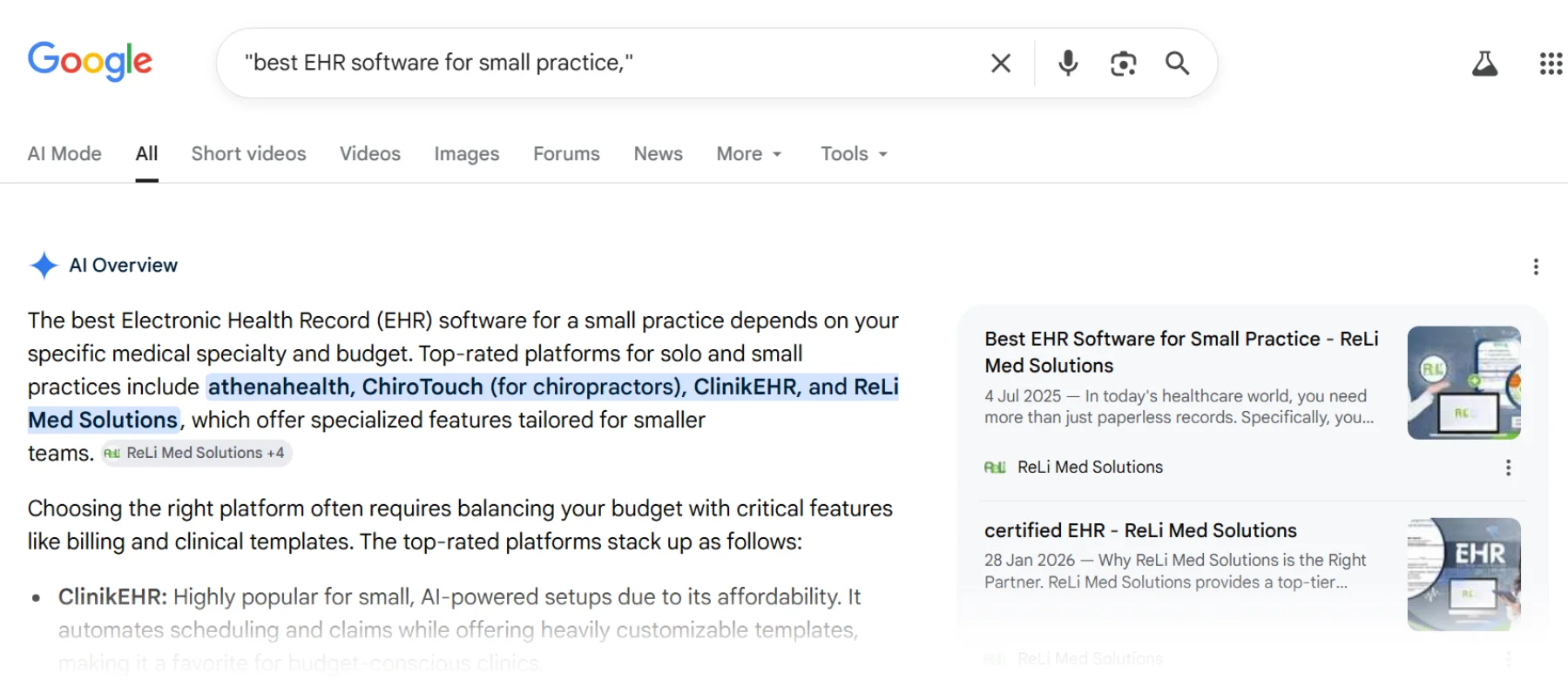
AI Mode is a separate, more advanced experience accessed via its own tab in Google Search. It handles complex queries that need deeper reasoning, multi-step comparisons, and follow-up conversations.
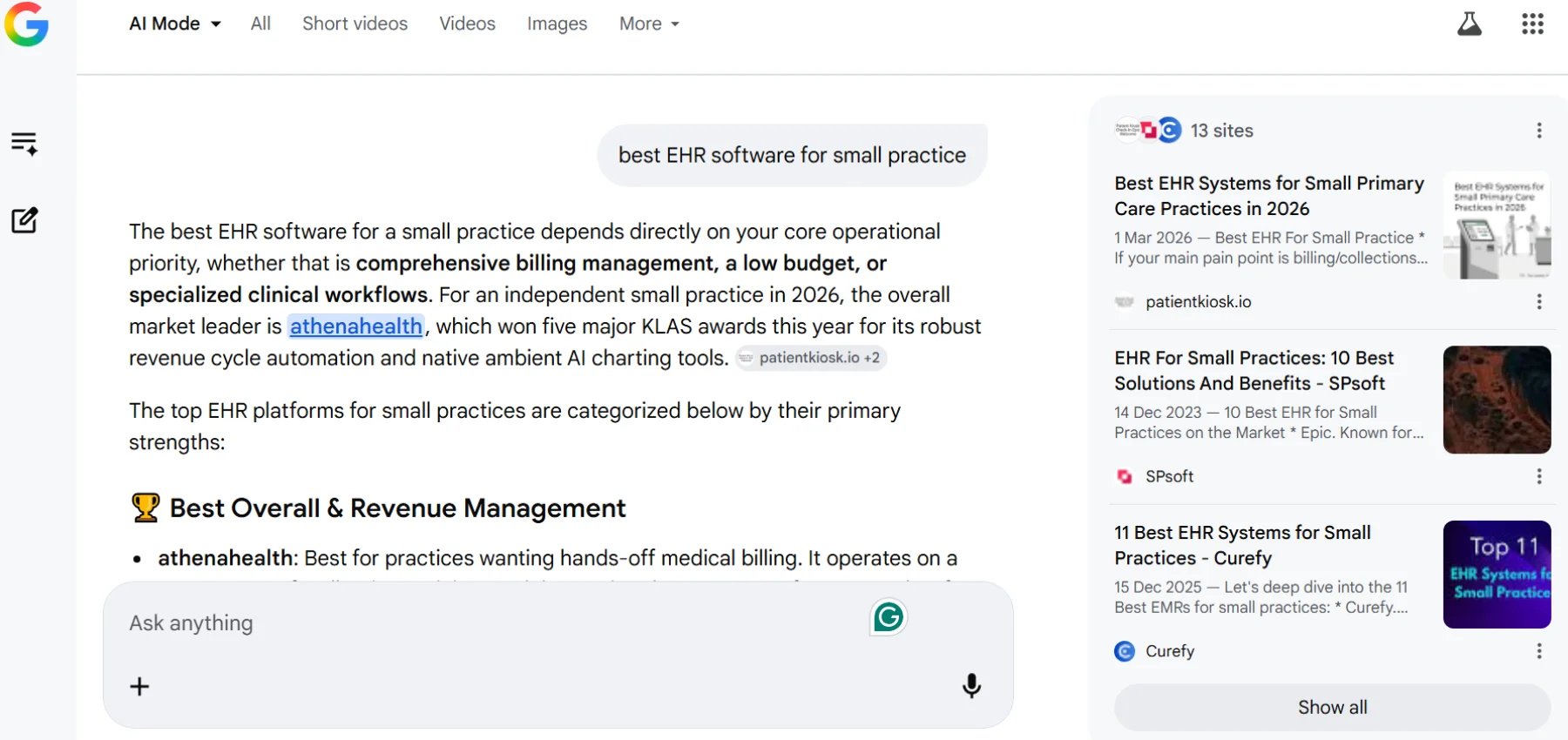
Users who choose AI Mode are actively opting in; they're deep in a research process, weighing options, or working through a nuanced decision.
This is important for B2B businesses where purchase decisions involve multiple stakeholders, internal approvals, and detailed evaluation processes. Visibility during these research-heavy moments can influence vendor consideration well before a prospect submits an enquiry form.
AI Mode is growing fast, but it remains distinct from standard search.
Both features run on two core technologies:
- Retrieval-Augmented Generation (RAG) is how Google's AI grounds its responses in real, current web content. Instead of generating answers from memory, it retrieves relevant pages from its search index, reads them, and weaves the information into a response with clickable source links. Your content can still be cited and linked even when AI is generating the answer. AI Mode uses a more advanced, multi-stage version of this reasoning across several sources at once, but the principle is the same.
- Query Fan-Out means Google's AI doesn't just process the literal question typed. It quietly generates a set of related, concurrent searches to build a broader context. Someone searching "best EHR software for small practice" triggers the AI to also search pricing, setup time, and feature comparisons, even if the user never typed those words.
8 Strategies to improve your B2B website visibility in Google's AI search features
1. Create valuable, non-commodity content
Google's AI systems are designed to find and recommend content that is unique, reliable, and genuinely useful. They can spot content that simply repeats what's already on the internet, versus content that offers real insight, experience, or expertise.
For Example:
- Commodity content looks like this: "7 Tips for Choosing a CRM System." It's broad, generic advice that already exists on countless blogs. Any competitor could write it, or an AI tool could generate it in seconds. It doesn't add much beyond what someone could find in a quick search.
- Non-commodity content looks like this: "How We Reduced Sales Cycle Time by 32% After Switching CRMs: A Breakdown of Our Actual Workflow Changes." This is based on real experience, specific results, and practical details about what actually changed inside a business.For B2B organisations, this type of experience-led content performs particularly well because buyers are looking for proof, implementation insight, and commercial outcomes rather than generic marketing advice
The key question to ask yourself is: what do you know about your industry, your customers, and your products that nobody else knows? That's what should shape your content.
Here are some practical ways to create non-commodity content:
- Draw on first-hand experience. What has actually worked or failed in real client or project work
- Use original data, internal insights, or case studies wherever possible
- Go beyond stating facts. Explain your reasoning, share what you'd recommend, and say why it matters
- Write clearly and logically so that readers can follow your thinking easily
- Support your points with relevant visuals like charts, screenshots, or videos, which can also appear in AI-driven search results
If you're thinking about how to build a content strategy that goes beyond surface-level blogging, KLIQ's B2B content marketing strategy playbook is a place to start.
2. Structure your B2B content so AI and readers can understand
Lead with the answer, then explain it. If your key insight is buried several paragraphs in, neither your reader nor an AI system will wait around to find it.
Google recommends organising content with descriptive headings, clear paragraphs, and logical sections that help people navigate the page. The same logic applies to how AI systems pull out and cite information. If your content is well-organised, it's much easier for AI to understand and reference.
Here are a few structural formats that work particularly well:
- Comparison tables make it easy to evaluate options at a glance and show up frequently in AI-generated answers
- Lists help readers scan through information quickly and help AI systems identify individual, citable points
- FAQ sections are among the most cited formats of all, because they give AI exactly what it needs: a clear question followed by a direct answer
A good move is to add a structured FAQ section to every major page on your site. Pull questions from your sales team, your support inbox, or the "People Also Ask" section that appears in Google for your key topics. Write a two-to-four sentence answer for each question. These are essentially AI citations waiting to happen.
When a buyer scans your page and immediately understands what you offer, they're more likely to take the next step. Whether that's booking a demo, requesting a proposal, or forwarding your page to a colleague involved in the buying decision.
3. Build comprehensive and in-depth B2B resources
Google's AI tends to favour content that covers a topic thoroughly enough to actually be useful, rather than surface-level summaries that leave people with more questions than they started with.
This doesn't mean padding your pages with unnecessary filler. It means covering a topic so thoroughly that your page becomes the go-to reference. You need to understand the full journey your customer takes on a particular topic, what they need to know at each stage, and the questions they will have along the way.
If you sell solar energy systems, for example, don't just publish a few hundred words about your product specifications. Write a comprehensive guide for Australian homeowners on switching to solar. Cover every meaningful angle, feed-in tariffs, state rebates, battery storage options, grid connection requirements, and the differences between Australian states and territories. Anticipate the follow-up questions. A genuinely useful, well-developed resource will consistently outperform ten thin pages of marketing copy.
Research shows that 60% of B2B buyers say strong thought leadership makes them willing to pay a premium to work with that firm. The investment in depth isn't just an SEO play; it's a commercial signal that your business understands the problem better than anyone else.
It's also worth knowing that Google explicitly warns against creating separate pages for every possible search variation just to capture more traffic. That approach is becoming less and less effective. Google's AI understands relevance without exact keyword matches, so fewer, deeper pages will always beat more shallow ones.
Look at your two or three most commercially important topics. Do you have one comprehensive resource for each? If not, that's your next content priority. Our guide on B2B SEO in the age of AI search covers how B2B leaders should be approaching this shift in practice.
4. Add high-quality images and video
AI-powered search features can surface images and videos alongside text, not just links to web pages. That means every piece of visual content on your site is an additional opportunity to appear in AI responses on top of whatever your written content is already doing.
If your pages would benefit from a supporting image, diagram, or short explainer video, add them. Make sure they're properly optimised, give them descriptive file names and alt text, and compress them so they load quickly. If you're already following standard image and video SEO practices, you're already in a good position for this.
Go through your most important pages and ask: is there anything visual, a diagram, a screenshot, a short video that would make this content more useful? If the answer is yes, add it with proper optimisation.
5. Build a crawlable technical foundation for your B2B content hub
Content quality matters most, but your technical setup is what actually allows Google to find and use your content. If your pages aren't crawlable and indexed, they don't exist as far as AI search is concerned.
- Get indexed and eligible for snippets. Pages blocked by robots.txt, tagged with noindex, or missing from Google's index won't be considered for AI features at all. Check your indexing status regularly in Google Search Console.
- Make your content crawlable. For larger sites, review your crawl budget to ensure Google's bots spend time on your most important pages.
- Use semantic HTML. Use heading tags (H1, H2, H3) to create a clear content hierarchy, structure content with proper paragraphs, and avoid large walls of text.
- Handle JavaScript carefully. If your site relies heavily on JS frameworks, make sure critical content is accessible to crawlers, not just visible to visitors. Test regularly to confirm content is being rendered and indexed correctly.
- Provide a good page experience. Site speed and mobile usability factor into both traditional and AI-powered search results.
- Reduce duplicate content. Audit your site for duplicates and use canonical tags to point Google to your preferred version of each page.
- Use Google Search Console. It shows exactly how Google sees your site, which pages are indexed, which have errors, which queries are driving traffic, and where the gaps are.
For B2B organisations investing in SEO, technical issues can directly impact lead generation by limiting how visible key service pages, solution pages, and educational resources are within both traditional and AI-powered search results.
6. Build your brand presence beyond your own B2B website
Google's AI doesn't just look at your website to decide whether your brand is worth recommending; it looks at the whole web.
You need to think about where your customers go to learn about your industry: the publications they read, the podcasts they listen to, the review sites they check. Those are exactly the sources Google's AI pays attention to.
Getting mentioned in an industry publication, appearing on a "best of" list, writing a guest article, being featured on a podcast, and earning genuine customer reviews all add up to whether Google sees your brand as credible and worth recommending. Being a brand that people actively search for and talk about carries more weight than simply having lots of links pointing to your site.
Google can detect fake mentions. Paid placements, manufactured forum posts, and bought citations get filtered out and can actually hurt you. Only genuine, earned mentions count.
Find five industry publications your customers actually read. Pitch an article, offer expert commentary, or get your leadership quoted in relevant stories. Collect honest reviews on the platforms that matter in your sector.
When a potential buyer has already seen your brand in several trusted places, they arrive warm, and the conversation is easier before it even starts.
8. Strengthen the trust signals that support B2B conversions
Google's AI strongly favours content from sources it considers credible. It evaluates this through a framework called EEAT, which stands for Experience, Expertise, Authoritativeness, and Trustworthiness. These are the signals Google uses to decide whether your content is worth citing and recommending to users.
This applies across every sector, but it gets extra scrutiny in areas like healthcare, finance, and legal, where bad advice could cause real harm to people.
The things that make the biggest difference are:
- Named authors with real credentials. Every important piece of content should have a named author with a short bio that explains why they're qualified to write about the topic. Anonymous content is increasingly at a disadvantage.
- Citing credible sources. Referencing reputable external sources within your content shows Google and your readers that your thinking is grounded and honest.
- Being transparent about who you are. A clear About page, a physical address, contact details, and a company history all contribute to how trustworthy your site appears to both users and search systems.
- A solid review profile. Google pulls review signals from multiple platforms. Strong, consistent reviews on Google, Trustpilot, or sector-specific sites reinforce your authority across the board.
If a customer is weighing up two similar options, they'll go with the one that feels more credible and trustworthy. Getting these signals right improves both your AI search visibility and your ability to turn visitors into customers. If you are looking at how to build and scale content that earns this kind of trust, our guide on building a successful B2B AI and human content workflow is worth reading alongside this one.
Is your B2B content ready for Google’s AI Search results?
AI-powered search is changing how customers find businesses like yours every single day. You don't need to master any secret tricks or chase the latest hacks. Focus on creating genuinely useful content, keep your website technically sound, and build a brand people actually trust. Do those things consistently, and Google's AI will have every reason to recommend you.
The businesses winning in AI search right now aren't the ones doing anything flashy; they're the ones doing the basics brilliantly. If you're not sure whether your website is doing the basics well enough, we can guide you.
At KLIQ Interactive, we work with B2B organisations across Australia, APAC, and Europe to help build search strategies that perform in both traditional and AI-powered results. From technical SEO and content structure to brand authority.
Our team helps you understand where your visibility gaps are impacting qualified traffic, lead generation, and pipeline growth across both traditional and AI-powered search environments. As search behaviour evolves, businesses that improve discoverability during early-stage research journeys are better positioned to influence buying decisions before competitors even enter the conversation
Get in touch with our team of B2B SEO experts for a detailed audit of your current search presence and a clear understanding of how your website is performing in the generative AI search landscape.
FAQs
AI Overviews sit at the top of standard Google results for informational or comparison queries. AI Mode is a separate tab for complex, multi step research, letting users ask follow up questions. Both use AI to summarise sources, but AI Mode suits deeper B2B buying research.
Google's AI search features rely on large language models that use Retrieval Augmented Generation to pull real, current content from its index, plus Query Fan Out, which quietly runs related searches to build a fuller picture before generating a direct, linked answer.
RAG is how Google's AI grounds its answers in real, current web content rather than memory alone. It retrieves relevant pages from the search index, reads them, then weaves the information into a response with clickable source links, so your content can still be cited.
Query Fan Out is when Google's AI generates a set of related, concurrent searches beyond the literal question typed, building broader context. A search for best EHR software also triggers searches on pricing and setup time, so content needs to cover the full topic thoroughly.
We recommend focusing on original, experience based content, clear structure with headings and FAQs, comprehensive resources on core topics, strong technical SEO, and credible brand signals such as named authors and genuine reviews. See our guide on building a B2B content hub: https://kliqinteractive.com/insights/b2b-content-hub-seo-ai-search-conversion/
FAQ sections are among the most cited formats in AI generated answers because they present a clear question followed by a direct response, exactly what AI systems need to extract and reference. Adding a structured FAQ to every major page increases the chance of being cited.
EEAT stands for Experience, Expertise, Authoritativeness and Trustworthiness. Google uses this framework to judge whether content is worth citing in AI search. Named authors, credible sources, transparent company details and strong reviews all strengthen EEAT and improve AI search visibility for B2B brands.
Non-commodity content is original, experience led material, such as a real case study or first hand data, rather than generic advice already available elsewhere. B2B buyers and AI systems both favour this depth because it demonstrates real expertise instead of repeating what everyone else says.
Technical SEO determines whether Google can even find your content. Pages blocked by robots.txt, tagged noindex, slow to load or poorly structured with unclear headings will not be considered for AI features, no matter how strong the writing, so a crawlable, well indexed site is essential.