May 17, 2026
How to Use SEO with ABM to Engage High-Value B2B Accounts
Share:



Modern B2B SEO and lead generation strategies are no longer just about ranking for keywords. They now play a central role in driving enterprise lead generation, pipeline growth, and account-based marketing (ABM).
While ABM focuses on targeting specific high-value accounts, B2B SEO ensures those accounts actually find your business during their research phase. This creates a powerful alignment between SEO, ABM, and B2B content strategy for lead generation.
Most buyers today conduct extensive online research before speaking with sales. If your brand is not visible during that research journey, competitors win attention first. However, many companies still separate SEO and ABM. One focuses on traffic. The other focuses on accounts. But when combined, they create a scalable system for enterprise SEO, B2B lead generation, and revenue growth.
This article explains how modern B2B SEO supports lead generation, enterprise visibility, and ABM performance across the entire buying journey.
Key takeaways:
- ABM is a strategic approach to understanding your target audience. SEO, advertising, socials, and email are different channels used to reach the ABM audience.
- Map keywords to the full buying journey (awareness, consideration, decision) to influence prospects before competitors enter the conversation.
- Build service-specific landing pages to speak directly to each vertical, improve relevance, and strengthen trust with decision-makers.
- Create content hubs around key account priorities to build authority, keep buyers engaged, and guide them through research with connected content.
- Align SEO with sales and paid channels so every touchpoint reinforces the same message across search, ads, and outbound outreach.
- Address multiple stakeholders in the buying committee by creating content tailored to different roles, like finance, technical teams, and leadership.
7 Steps to use SEO with ABM to engage high-value B2B accounts
Step 1: Start with your account list, not a keyword tool
Traditional SEO starts with keyword research. Modern enterprise SEO for B2B lead generation starts with target accounts and Ideal Customer Profiles (ICP).
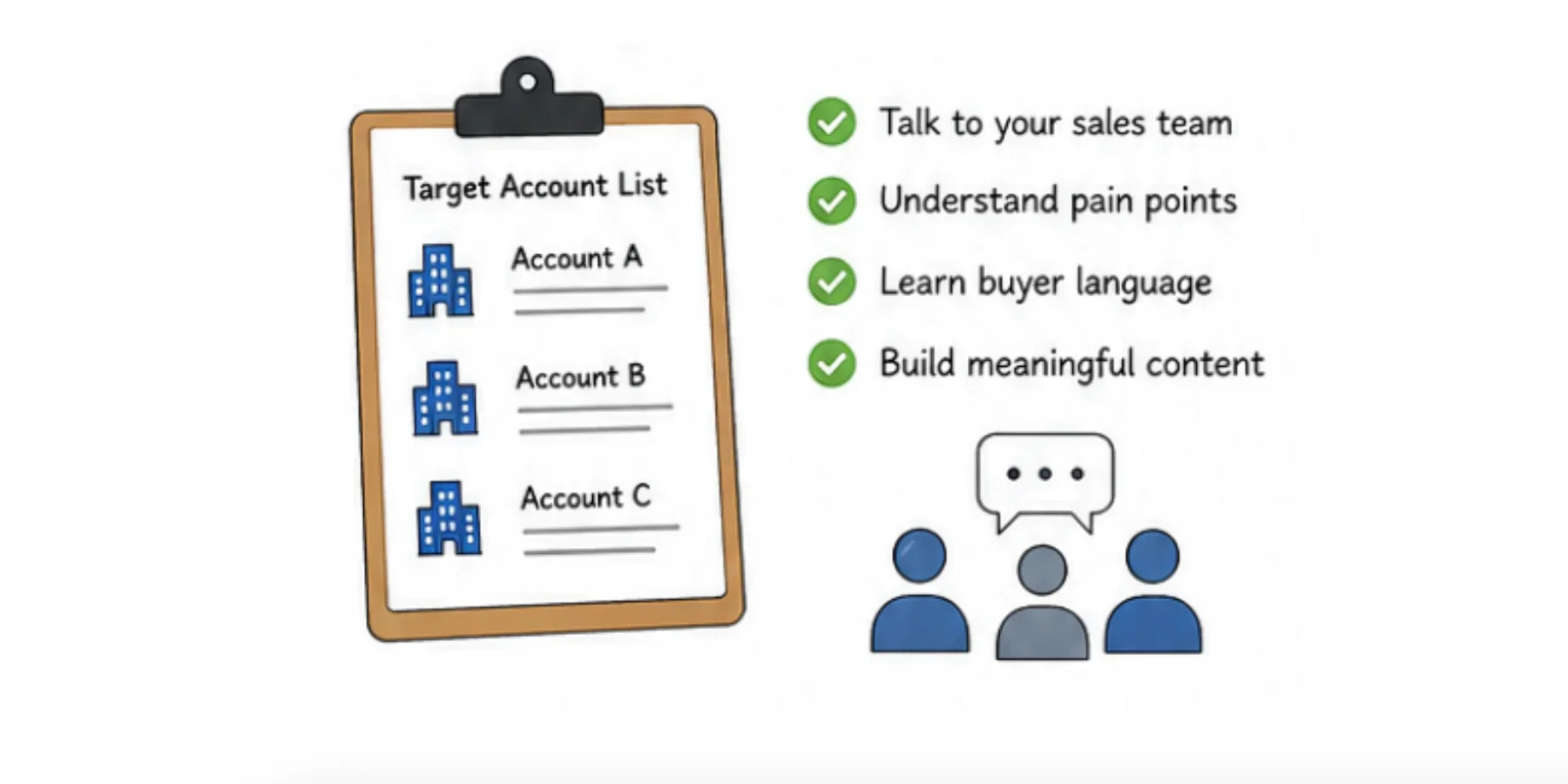
Before you open any keyword tool, ask your sales team:
- Which companies/accounts are we targeting?
- Who is the buying party? Decision makers vs influencers.
- Company size, revenue, industry, job titles, job functions, etc
- What are the biggest pain points our best customers faced before finding us?
- What objections come up most often in sales conversations?
- What does a prospect usually Google right before they call us?
These conversations are gold. Sales teams have already had hundreds of conversations with the exact buyers you're trying to reach. That insight about the language buyers use, the problems they're trying to solve, and the alternatives they're considering should be the foundation of your SEO content strategy.
Example:
A B2B cybersecurity company targeting mid-market financial services firms may learn from its sales team that CFOs and CISOs consistently prioritize questions about compliance with specific regulations.
This insight should directly shape the content strategy. Instead of creating broad “cybersecurity solutions” pages, the focus should shift to detailed content on regulatory compliance, audit readiness, and risk management frameworks tailored to financial services.
This approach shifts SEO from traffic generation to qualified B2B lead generation and enterprise pipeline influence.
Step 2: Map intent-driven keywords to the buying journey
Not all searches are equal. A buyer early in their journey searches very differently from a buyer who's ready to make a decision. Understanding this distinction, what's often called search intent is critical to an ABM approach.
Here are the three main stages of the B2B buying journey and how search behaviour typically changes as buyers move closer to making a purchasing decision.
1. Early-stage (awareness)
The buyer knows they have a problem, but isn't sure what the solution looks like. Searches at this stage are broad and question-based.
Examples:
"How to reduce customer churn in SaaS,"
"What is the cost of employee turnover?"
"Best practices for supply chain visibility."
2. Mid-stage (consideration)
The buyer understands the solution category and is evaluating options. Searches become more specific.
Examples:
"CRM vs marketing automation for B2B,"
"Salesforce alternatives for mid-market,"
"ABM platforms comparison."
3. Late-stage (decision)
The buyer is close to choosing. Searches are brand or product-specific.
Examples:
"[Your Company] reviews,"
"[Your Company] vs [Competitor],"
"[Your Company] pricing."
A strong B2B SEO lead generation strategy focuses heavily on awareness and consideration stages, where influence is strongest, and competition is lower.
Step 3: Build industry-service Landing pages for ABM
These service landing pages are sometimes called a vertical page or a solution page. Instead of generic service pages, modern enterprise SEO strategies use industry-service landing pages to improve both ABM targeting and B2B lead generation performance.
Each page speaks directly to the problems, terminology, regulations, and priorities of that specific audience.
Why does this work so well?
First, it improves your relevance for industry-specific searches. For instance, a healthcare technology company searching for "patient data management software" is much more likely to engage with a page specifically written for healthcare, one that mentions Health Insurance Portability and Accountability Act (HIPAA), Electronic Health Records (EHRs), and clinical workflows, than a generic software solutions page.
Second, it signals to Google that you have genuine expertise in that vertical, which supports your rankings over time.
Third, when your sales team sends personalised outreach to target accounts, they can link directly to the industry-specific page rather than a generic homepage, making the follow-up far more relevant and effective.
When building your industry-specific pages, make sure each one includes:
- Industry-specific language and terminology (the words your buyers actually use)
- Relevant pain points and challenges unique to that sector
- Case studies or testimonials from companies in that industry
- Relevant compliance, regulatory, or operational context
- A clear call to action tailored to that audience
Step 4: Build content hubs for enterprise SEO and B2B lead generation
A content hub is a cluster of interconnected content around a central topic, a pillar page supported by a series of more specific articles, guides, and resources. In this case, you build content hubs around the priorities of your target accounts. This is where content hubs become powerful.
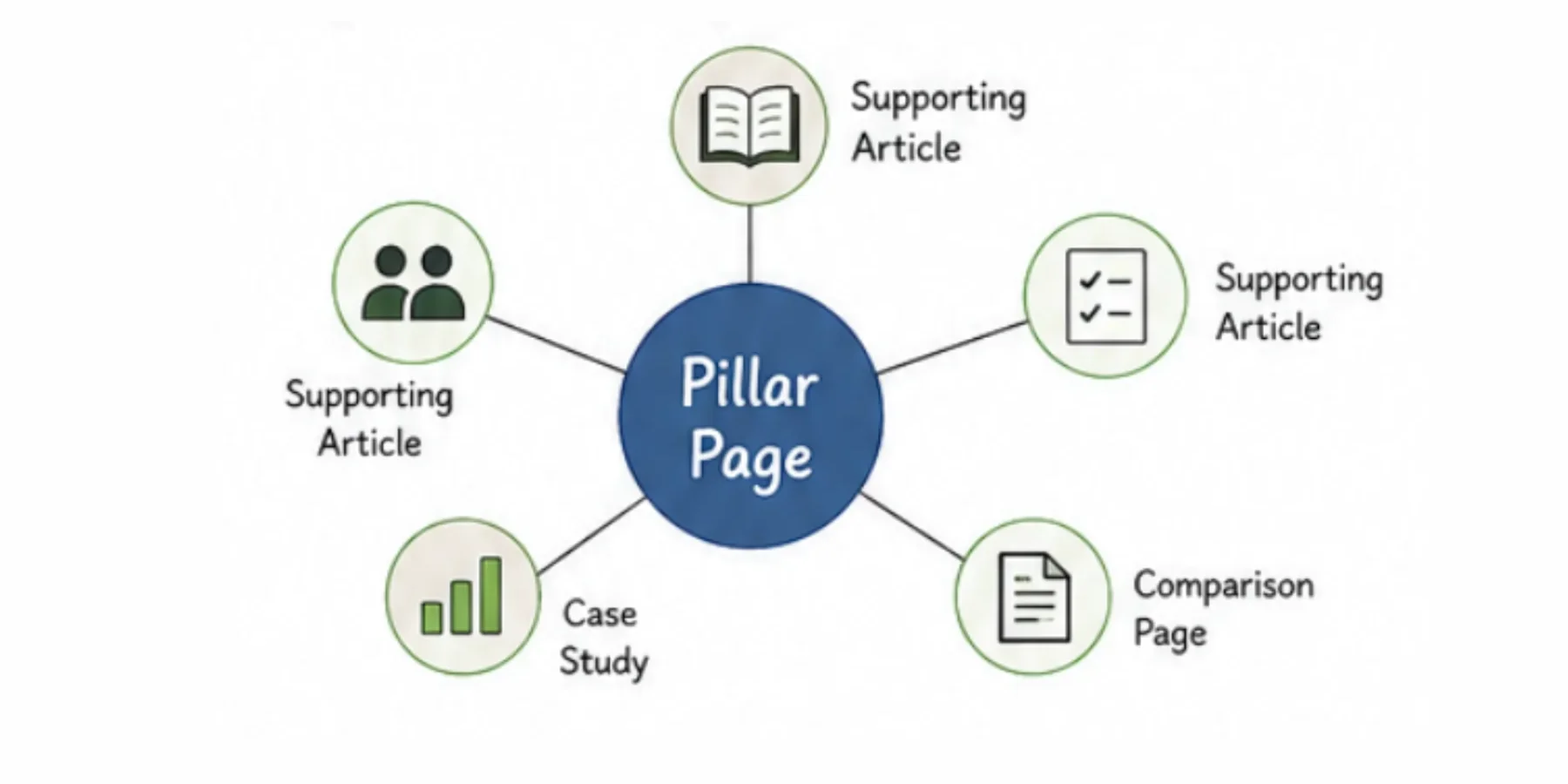
This approach serves two purposes simultaneously. It signals topical authority to Google, which helps your rankings. And it creates a rich resource that target accounts keep returning to during their research, reinforcing your brand's expertise and relevance.
For example, here's what a content hub might look like for a B2B HR technology company targeting enterprise manufacturing firms:
Pillar page:
- The Complete Guide to HR Technology for Manufacturing Companies
Supporting articles:
- How to Manage Shift Scheduling Across Multiple Sites
- Reducing Turnover in Manufacturing: A Practical HR Playbook
- How to Onboard Seasonal Workers at Scale
Case study:
- How [company] Cut HR Administration Time by 40%
Comparison page:
- HR Software Built for Manufacturing vs Generic Platforms
Every piece of this hub is built around the real concerns of a manufacturing HR leader. When that person searches for any of these topics, they land on your content.
Over time, your brand becomes the go-to resource in their mind, so when they're ready to buy, you're the obvious first call.
Producing this volume of targeted content across multiple verticals can feel like a big undertaking. That's where AI can make a real difference, read How to Scale Personalised ABM Content with AI to see how teams are doing it efficiently without sacrificing quality.
Step 5: Align SEO with sales intelligence for better lead generation
SEO content planning should not happen in a marketing silo. A successful enterprise SEO and ABM strategy requires tight alignment between marketing and sales teams.
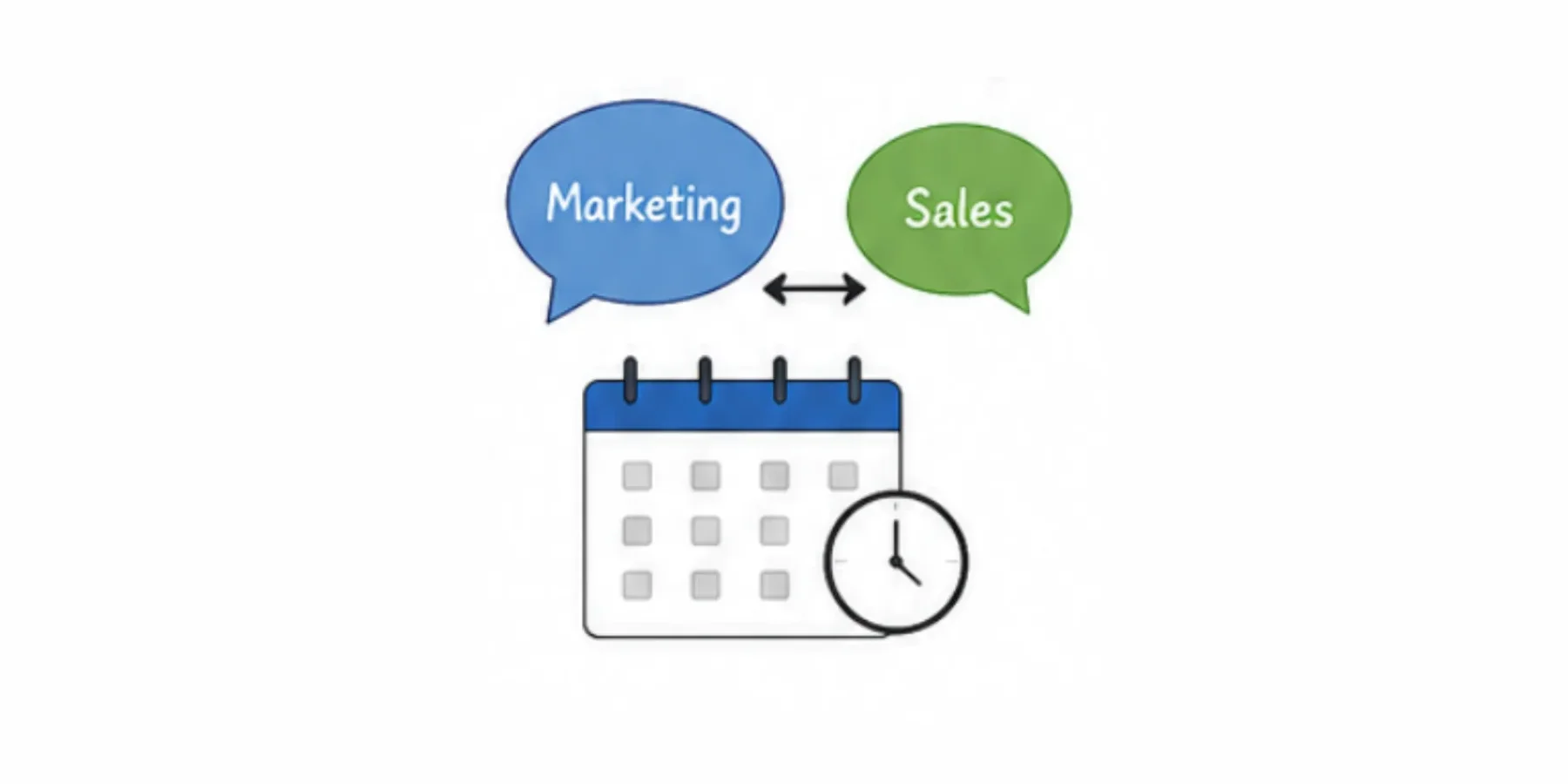
Set up a regular cadence, monthly or quarterly, where marketing and sales review:
For instance:
- Which target accounts are actively in conversations
- What objections are coming up most frequently
- Which industries or segments are showing the most traction
- What content sales wishes existed to support their outreach
This ensures SEO directly supports B2B lead generation and revenue pipeline development.
For instance:
If your sales team is seeing a surge of interest from logistics companies and they keep running into the objection "we're worried about integration complexity," that's a signal to create content that directly addresses integration, a detailed guide, a technical FAQ, or a case study showing a smooth implementation.
That content immediately serves both SEO (capturing future searches on the topic) and sales (giving reps a credible resource to share mid-conversation).
Step 6: Integrate SEO with paid media and outbound for full-funnel lead generation
SEO doesn't work in isolation in an ABM strategy; it works as part of a connected system.
Think of it this way: SEO earns your presence in organic search. Paid media (LinkedIn Ads, Google Ads, display retargeting) reinforces that presence.
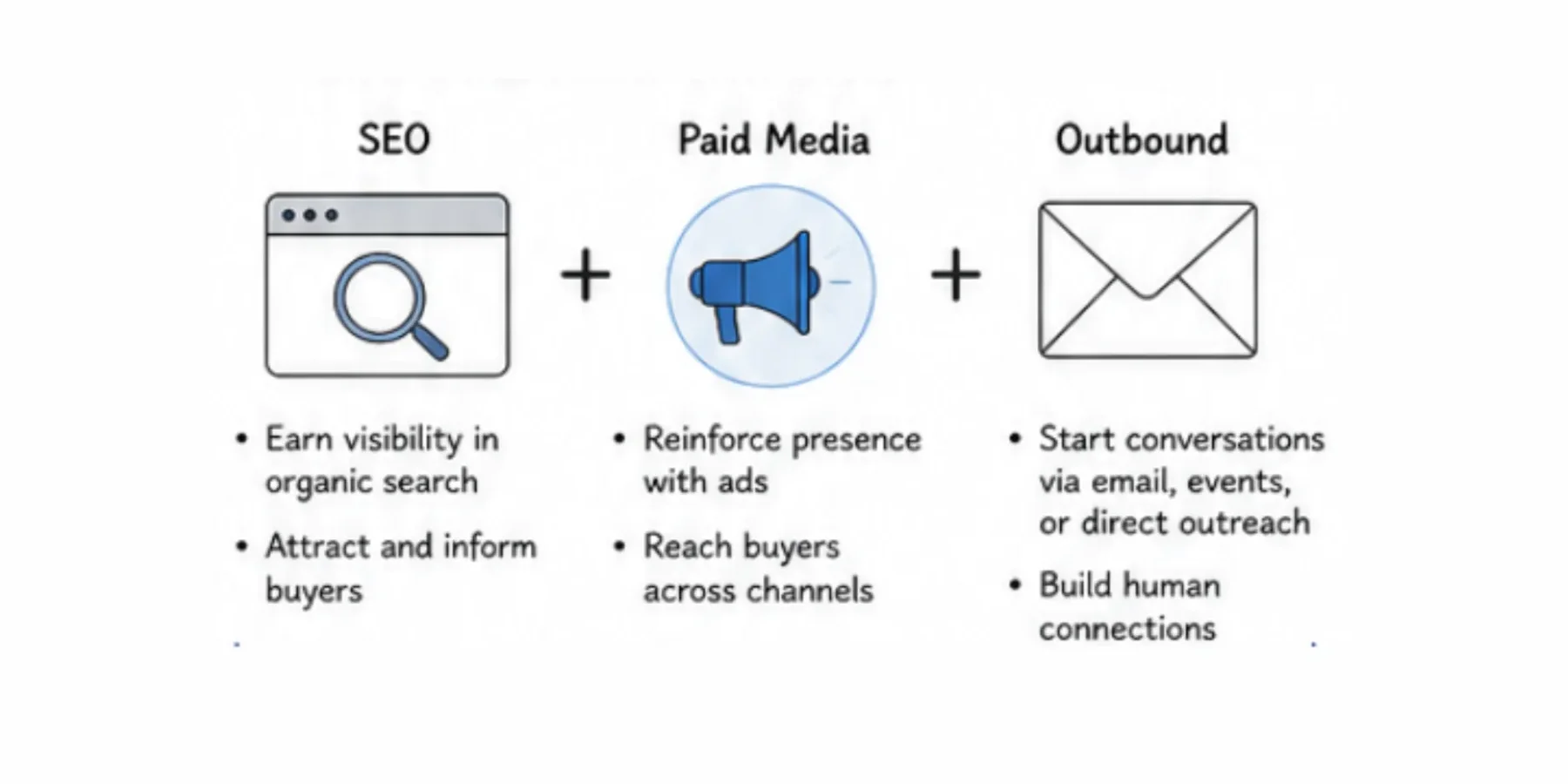
And outbound outreach (email, direct mail, events) makes the human connection. When these three work together around the same target account list, the effect is exponentially stronger than any one channel alone.
Here's how the integration works in practice:
SEO with LinkedIn Ads
Publish educational, high-value content such as practical guides tailored for C-suite executives. This type of content can then be promoted through LinkedIn Ads as sponsored posts, specifically targeting a relevant executive audience.
With an SEO and LinkedIn Ads approach combined, a piece of content can be developed for a specific vertical, for example, a guide designed for CFOs in the manufacturing sector. That same content is then distributed through LinkedIn Ads aimed at CFOs within manufacturing companies.
This creates visibility across both organic search and paid social channels. When decision-makers from target accounts search related topics on Google and also encounter the content on LinkedIn, brand presence is reinforced across multiple touchpoints.
For a deeper dive into integrating LinkedIn with an account-based marketing strategy, refer to LinkedIn and Account-Based Marketing (ABM).
SEO with Retargeting
When a visitor from a target account lands on your website through organic search, retargeting pixels capture that visit. You can then serve them highly personalised display ads across the web, keeping your brand top of mind as they continue their research. The organic visit becomes the entry point for an extended, multi-touch engagement.
SEO with Outbound
When a sales rep reaches out to a prospect at a target account, they can reference content, such as a recent article, an industry report, or a relevant case study, that the prospect may have already encountered. This makes the outreach feel less cold and more like a natural continuation of a conversation the prospect was already having with your brand.
This is what separates mature ABM programs from basic ones. SEO ensures you're present in the moments that matter. Paid and outbound ensure you stay present and deepen the relationship.
Step 7: Optimise for the people who influence the deal
In B2B, buying decisions are rarely made by one person. Research consistently shows that the average enterprise buying committee involves up to 10 stakeholders.
Your ABM- SEO strategy needs to account for all of them.
That means creating content that speaks to different roles within the same target account type. Map out the key stakeholders in your typical buying committee and create content tailored to each one's priorities:
- End users care about ease of use, time savings, and day-to-day workflow impact
- Technical evaluators care about security, integration, scalability, and implementation
- Finance stakeholders care about ROI, total cost of ownership, and contract terms
- Senior leaders care about strategic outcomes, competitive advantage, and risk
When each of these people searches during their research, they should all be able to find content from you that speaks directly to their concerns. This increases the chances that your brand is positively received across the entire buying committee, not just by the champion who first discovered you.
Use strategic SEO to support ABM for B2B growth
The best ABM programs don’t just react to buyer intent, they shape it.
When your SEO strategy is aligned with your target accounts’ world, you show up in the moments that matter most: the quiet research moments that happen long before any sales conversation begins. You answer the questions buyers are already searching for and build trust before your sales team even reaches out.
B2B companies that successfully combine SEO and ABM don’t just attract more traffic. They build visibility, credibility, and influence with the right decision-makers across the entire buying journey.
At KLIQ Interactive, we help B2B organisations connect SEO and ABM into a more measurable growth strategy through KLIQmetrics™. Our marketing analytics dashboard provides deeper visibility into how your SEO, content, and account-based marketing efforts are performing, including emerging AI and LLM search visibility trends that are increasingly influencing how B2B buyers discover and evaluate brands online.
If your SEO strategy is generating traffic but not attracting the right accounts, or your content is struggling to support meaningful pipeline growth, the issue may not be SEO alone but how it aligns with your broader ABM strategy.
Connect with our team of SEO and digital strategy experts who work with organisations across Australia, APAC, and Europe to help improve SEO performance, through data-led recommendations, with a strong focus on buyer intent, search behaviour, and the growing impact of AI and LLMs on how decision-makers discover and evaluate businesses online.
FAQs
ABM is a strategic approach to identifying and engaging specific high value accounts, while SEO, along with advertising, social and email, is one of the channels used to reach that audience. Combined, SEO ensures target accounts actually find your business during their research phase.
KLIQ starts with a client's account list and Ideal Customer Profile rather than a keyword tool, asking sales which companies are being targeted, who the decision makers and influencers are, and what a prospect usually searches right before they call, then confirming this with keyword research.
KLIQ maps B2B SEO content to three buying stages: early stage awareness, where searches are broad and question based, mid stage consideration, where buyers compare named solution categories, and late stage decision, where searches become brand or product specific, such as pricing or direct comparison queries.
An industry service landing page, sometimes called a vertical or solution page, speaks directly to the terminology, pain points and regulations of one specific audience rather than generic service copy. KLIQ builds these pages to improve relevance for industry searches and signal genuine expertise to Google.
Research shows the average enterprise buying committee involves up to 10 stakeholders. KLIQ's SEO and ABM strategies tailor content to each role, since end users, technical evaluators, finance stakeholders and senior leaders all care about different outcomes when researching a B2B purchase.
KLIQ sets up a regular cadence, monthly or quarterly, where marketing and sales review which target accounts are in active conversations, what objections come up most often, and what content sales wishes existed, so SEO directly supports pipeline growth rather than sitting in a marketing silo.
In KLIQ's approach, SEO earns organic presence, paid media such as LinkedIn Ads and Google Ads reinforces that presence, and outbound outreach makes the human connection. When these three channels focus on the same target account list, the combined effect is far stronger than any single channel alone.
KLIQ builds content hubs around the priorities of target accounts to signal topical authority to Google while giving accounts a reason to keep returning during research. A pillar page plus supporting articles, case studies and comparison pages keeps a brand front of mind. See KLIQ's content workflow guide: https://kliqinteractive.com/insights/how-to-build-successful-b2b-ai-human-content-workflow/
KLIQmetrics™ is the B2B marketing analytics dashboard built by KLIQ, a B2B SEO agency, giving marketers deeper visibility into how SEO, content and account based marketing efforts are performing together, including emerging AI and LLM search visibility trends that increasingly influence how buyers discover and evaluate brands.